Thursday, June 23, 2011

How I joined The Comedy Company


In my teens and twenties, I was lucky enough to have a few children's books published. But the money really was extraordinarily bad unless you built up a huge backlist or wrote The Lord of the Rings, and it didn’t look like I was going to do either. I thought the way to make money would be to write comedy scripts for TV and radio. There was only one place in Melbourne at the time where you could study that, and that was The Victorian College of Arts. They accepted only a small number of students per year – thirty or so – and they wanted to make sure you’d be able to support yourself financially for those three years, so they asked you to write down how exactly you’d do this. Arrogantly I wrote down ‘royalties’ – which was a lie because there’s no way I could have supported myself on those alone, but that got me in.

Trying far too hard to be funny in a show I wrote at The Victorian College of Arts.

I graduated after three years, and wrote more kids' books that still didn’t make any money. But I now had this diploma that said I could write TV and radio scripts. So I also started sending comedy scripts away to TV and radio and in the end they started buying them. In the eighties, ABC Radio had a Comedy Unit that put together sketch programs to which I would contribute. I remember one was called Don't Get Off Your Bike. They paid quite well and the shows were highly produced. But ABC Radio eventually got rid of its Comedy Unit, which I thought was a pity. Then I got a weird break. One of the ABC producers thought I had a nice voice and she gave me a weekly radio show on ABC Radio National. It was called Rave. I’d come on after The Country Hour and before Baroque and Beyond. It was the first show on Radio National to feature comedy and rock music. It was also the last. But it gave me the opportunity to interview some of my comedy heroes, including Douglas Adams, Rowan Atkinson, Graham Chapman and Alexei Sayle. Since it went out live I also learned a golden rule of broadcasting, which is not to let a seriously drunk person on live radio. My interview with Ignatius Jones came to a sudden end when he fell off his chair.

After a Rave broadcast, with producer Debbie Richards. This is the only time Debbie Richards ever laughed at something I said. I wish I could remember what it was.

My real links with the Melbourne comedy scene happened as a result of Theatresports – the competitive improvisational drama game that became huge in the eighties and is still played in schools today. A lot of Theatresports is about panic. Back at the height of its popularity, you would be about to face an audience of two thousand people on some nights, and have no idea of what you were about to say or do. I was fortunate to be in a team that featured comedians Glenn Robbins and Maryanne Fahey, who weren't as fazed by it as I was. Though Glenn did vomit before one of the games.

During the first Melbourne Comedy Festival, a huge Theatresports event was staged at The Dallas Brooks Hall. Two thousand spectators watched my team, The Gutless Wonders, perform very badly. But I had one minor triumph. At a convenient moment, I discovered that I have a party trick that I'd never known about. I was very lanky back then, with loose ligaments. In one of the rounds we had to ad lib a short play about a murder in a computer games arcade. It wasn't going well. We were approaching the end of the game and nobody had been murdered. Then I got it into my head that the murder could be committed by one of the critters in an old fashioned Space Invaders game. So I tried to behave like one and it got this really big laugh and I had no idea why. The next night I saw myself on Channel Ten news, being a Space Invader. (Slow news day.) God, I looked freaky. The late great Peter Cook, who was the guest judge, decided that this performance was worthy of Moment of the Match, and he gave me the trophy. He did look puzzled when I got up on stage to collect it, and I suspect he might have got me confused with another player.
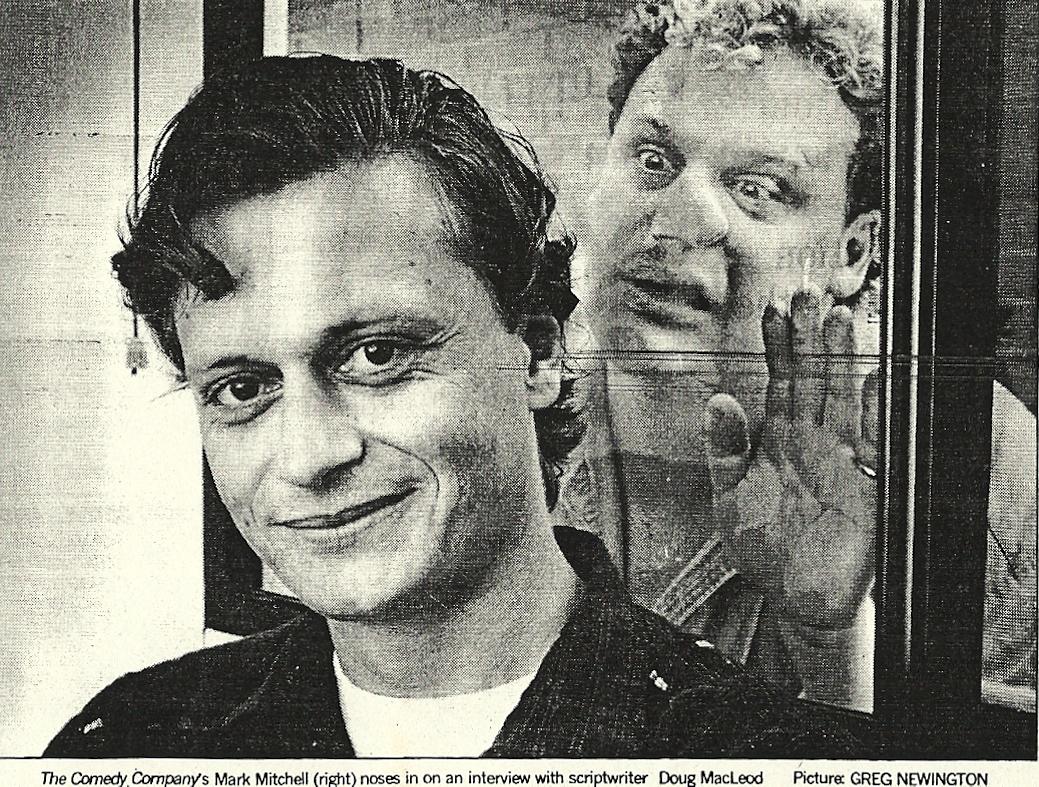
Trying to get a publicity shot without Mark Mitchell.

Out of Theatresports came my gig as head writer on the pilot of a TV sketch show called The Comedy Company for Channel Ten. It got picked up for a series of six, though it went on to run for two highly successful years and one unsuccessful one, and relaunched sketch comedy on commercial TV.

The first Comedy Company sketch I wrote was about a holiday resort where intellectuals went for meaningful relaxation. It was called Club Head (as opposed to Club Med) and it was a complete turkey. No one laughed. One of Glenn Robbins’ first sketches was Mum on the Run. It was a home delivery organisation that sent out these mums with plates of home-cooked meals – grey corned beef, bullet peas and Deb mashed potato – with rotund comedian Mark Mitchell dressed up like a mum emerging from a van. And Glenn’s stuff worked. People did laugh. As a seasoned stand-up comedian, Glenn knew that the real crowd-pleasing material was more to do with everyday stuff. He’d also trained as a teacher, so he had a fair idea about how kids thought, and it turned out that kids were a huge proportion of our audience.


Writers of The Comedy Company, 1989. That's Mick Molloy, back left.

By far the most successful part of the show was the set of characters that the cast invented and played. Schoolgirl Kylie Mole, played by Maryanne Fahey, became a national sensation, just as big as the other Kylie who was then the star of Neighbours. Glenn Robbins brought his lovable Uncle Arthur character to the second series, and rapidly charmed the audiences. Mark Mitchell will always be remembered as Con The Fruiterer - more about him later. Kim Gyngell, one of Australia's very best actors, shone every week as the clueless Colin Carpenter, whom everyone thought was based on a friend of theirs. When the show started, producer Ian McFadyen invited me to be in the cast of performers. I didn't want to do it. Being an award-winning Space Invader was enough for me. So I stuck to being head writer, with very occasional appearances in the show as a nun or a cockroach or something glamorous like that.

Your head writer on Sydney Harbour with Kim Gyngell and co-writer Peter Herbert.

The Comedy Company was rarely satirical or sophisticated. We didn't have high production values. We were nothing like Not the Nine O'Clock News, which was the ground-breaking English satire series that we all admired. But Ian McFadyen had a very clear view of the show. He wanted the hundreds of thousands of Neighbours viewers to watch his show as well. With the exception of Ian, we weren't a very academic bunch of writers. (I've since worked on sketch comedy shows where at least half the writers are lawyers.) I had nothing but a Diploma of Arts. Tim Smith worked for the Gas and Fuel Corporation. Russell Gilbert worked at an abattoir. When former Australian Prime Minister Bob Hawke appeared on one of the shows, I was embarrassed that two of our writers offered him a beer. It was widely known that Hawke didn't drink alcohol. But obviously not that widely known.

The Comedy Company has a special guest star.

Despite our dagginess, or because of it, we got well known very quickly. There was a lot of media attention. A Cleo journalist even asked me if I wanted to be in the running for their Bachelor of The Year award. I declined, because I wasn't a bachelor at the time. It wasn't due to any lofty ideals I had. If anything, I was just as hungry for publicity as Mark Mitchell. Actually, no, that isn't humanly possible. But I'm profoundly embarrassed by some of the things I am quoted as saying in the Australian media back then. When journalists are prepared to write whatever you say, and you yourself believe these inanities to be profound, you're going to come across as an egomaniacal prat. Some of my comments about a Greek shop-owner called Con the Fruiterer, arguably our most popular character, were very ill considered. At least, they read that way in the press. These quotes later appeared in someone's doctorate thesis, and I didn't come out of it very well. Mind you, the writer of the thesis had taken all of my quotes from a TV Week interview, and the magazine wasn't renowned as an accurate source.

Mark Mitchell flanked by his writing team. Peter Herbert and I wrote most of the Con the Fruiterer material.

I think the stupidest thing I said was that 'the price of sketch comedy is eternal vigilance'. It's a variation on a quote by Jefferson, who wrote that the price of liberty is eternal vigilance. I wanted to get across the idea that there was always so much demand for sketches to fill the show's weekly episodes, that I looked at everything in terms of whether or not it could somehow be transformed into a sketch. But it was a pretentious thing to say. When I later joined the writing staff of another sketch show, Fast Forward, which had much better production values than The Comedy Company, I was surprised that the writers knew about my 'eternal vigilance' remark and it kept cropping up, never flatteringly.

I join the writing team of a highly sophisticated, intellectual comedy show.

Back in 1987 I was extremely lucky to be in the right place at the right time. I had two extraordinary years with The Comedy Company, and I'm sorry it ended badly. After two years, Ian McFadyen wanted to give The Comedy Company a rest. But Mark Mitchell, Kim Gyngell and I wanted to keep doing comedy, even if it wasn't The Comedy Company. We were spectacularly naïve about how television works. When we were told that we would be free to devise new shows for the Network, we took management at face value. Of course, all the Network wanted was to keep The Comedy Company running on Sunday nights at 7.30, where it had been for nearly two years. Once I'd signed, it was made clear that Ten wanted me to get a replacement for The Comedy Company on air within about eight weeks. It was a horrible time. Ian McFadyen thought that the whole thing had been a calculated takeover bid on my part. Ian, as many people know, is brilliant but exasperating. He's one of those people who can be kind, then not kind, then affable all in the space of one sentence. He sent me legal letters promising that I would be in deepest shit if I dared use any ideas that had been generated during The Comedy Company's two year run. I'd never intended to, but the threats didn't make my job any easier. I was also in the weird situation of working for a TV network that was in receivership. While I was trying to make a show, accountants were wandering around looking for stuff to sell. The Australian economy had plummeted. Many Comedy Company people - myself included - had made poor investments and ended up losing much of the money we'd made. That didn't really bother me as much as the fact that what had been a real joy for two years ended up in so much acrimony.

But that was over twenty years ago. We're all friends again. Though Ian does still drive me mad.


Sunday, June 19, 2011

Who is Stephen Harris?


Splendid chap. All three of him.

Most science fiction fans will know what authors Arthur C. Clarke, Charles Willis and E.G. O'Brien have in common. The answer is, their DNA, since all three are the same man. There are all sorts of reasons for choosing a pseudonym. If you are known specifically for one type of work, but long to try your hand at another, then writing under a pseudonym means the reader comes to this new work with no preconceptions. Thus author Jennifer Rowe continues to write her crime novels under her given name, but her children's books under the name of Emily Rodda, and sometimes Mary-Anne Dickinson.

Emily Rodda's book, Pigs Might Fly, which won the CBC Book of the Year Award in 1987. The reason I'm so familiar with it is that I came second.

She's spectacularly successful, no matter which name she chooses. Sometimes authors believe they can escape legal action if they write scurrilous material under a pseudonym. This is risky, because if the book is a real hot potato, someone will usually blow your cover. Some authors have other high profile jobs and think they might lose credibility if the public also knows them for the raunchy novels they write in their spare time. Would you trust your surgeon if you knew that he or she also wrote gothic horror stories? There's no reason you shouldn't, of course, but people sometimes get funny about things like that.

The surgeon will see you now.

Gerald Wiley was a highly successful sketch writer, a key contributor to countless episodes of The Two Ronnies, a comedy show that gave us plenty of laughs in the seventies and eighties. It's still funny. You can see some fine examples of their work on YouTube. No one realised, but Gerald Wiley was one of the show's two stars. Nervous about submitting material under his own name, and not wanting to influence the production team one way or another, Ronnie Barker invented what must be the least glamorous pseudonym in history. I apologise to any Geralds or Wileys who may be reading.

The late, incredibly great Ronnie Barker.

 As more and more of Gerald Wiley's material found its way into the show, because it was very good indeed, there was a search for the elusive Mr Wiley, who gave no home address, merely a post office box number. In the end Ronnie Barker threw a party in order to introduce his alter ego. I get the feeling it would have been a very colourful affair.

... and it's good night from him.

As a rule, don't use a pseudonym unless you really feel that you must. Fantasy writers often come up with pseudonyms because they prefer them to their own mundane names. Trust me, a publisher will look more kindly on a manuscript written by Jan Burke than one by Morgana Starshine. I apologise again to any Morganas or Starshines that may be reading. It looks even worse for you if you put one of those copyright notices on the front of your manuscript. 'Copyright Morgana Starshine' simply isn't a good look, especially as Australian law means that your work is automatically your own copyright as soon as you've written it. Putting that little copyright symbol alongside your ornate pseudonym is telling your publisher two things: (1) I think you're a thief. (2) I'm probably mental.

Don't presume all unlikely sounding names are pseudonyms. A journalist once asked musician/satirist/actor/sex-god Eddie Perfect how he came to have such a weird pseudonym. Eddie replied, truthfully, that his parents were Mr Perfect and Mrs Perfect.

Mr and Mrs Perfect's bundle of joy.

This brings me to the only time I've ever used a pseudonym, one that is listed in the catalogue of the National Library of Australia. I once had a lot of fun with publisher Jane Covernton, carrying out a correspondence in the guise of a poetic nun called Sister Madge Mappin. But of course Jane found out, because she wanted to publish the book, and the whole thing became serious business. But Jane Covernton, who is one of the best publishers in this country, produced another book for which I supplied the text in 2009.

A really good book.

It's a beautiful thing, called Ballroom Bonanza, with artwork by local legend Nina Rycroft. Nina had done pictures of animals attending a gala dance event at the Tower Ballroom in Blackpool in England. Because Nina's grandfather Tommy Jones used to be the bandleader at this venue, Nina felt a particular attachment to the pictures. She went to Blackpool more than once to photograph the place, to make sure that the book was faithful to its subject matter - well, as faithful as a book about dancing animals can be. 


The only book in the world to feature numbats dressed as Tina Turner.

Even though Nina had the concept of the book in her head, she didn't have a text. Jane Covernton called me in to come up with the words. Because I liked the pictures so much, I was happy to write the text again and again until everyone was happy. I chose a pseudonym because I knew that my main publisher Penguin got antsy if I worked for other publishers.

Well, you try to think of an animal beginning with the letter U.

The pseudonym I chose was Stephen Harris. The American version of the book has a cover flap on which are the biographies of the book's creators. I had to make up stuff about Stephen Harris that was true of my own life, but that focussed on different aspects. Thus my early career in ABC radio suddenly became more important. The pseudonym led to other niggly little problems that made me wish I'd used my own name and been brave enough to stand up to Penguin.

This picture does not appear in Ballroom Bonanza.

Nina deserves a lot of kudos for the book. I hope it's one of those sleepers that will take off again one day, ensuring more fame and money for Nina and the pseudonymous, cringing Stephen.

I started this post by referring to science fiction fans. I wonder how many of them realise why I chose Stephen Harris as a pseudonym. Here's a clue.


Tuesday, May 31, 2011

Farewell to Bob


After he achieved such massive and belated success with Slaughterhouse Five, Kurt Vonnegut told journalists that he had written a new book called Breakfast of Champions but that it wasn't good enough to publish, so he was prepared to put it aside, away from the world's gaze. But of course, he did publish it, because it's unbearable to think that what took up so much of your life is going to make you no money. And he was right. Breakfast of Champions wasn't a good book. It was turned into a movie and that wasn't any good either. But worse was to come; Slapstick being the one that people tend to bang on about. And then, just when everyone thought that old Kurt Vonnegut might never write another good book, he came up with Jailbird, then Galapagos, then Bluebeard. Three great books, almost in a row. Deadeye Dick came between Jailbird and Galapagos. It wasn't too bad, but Jailbird was a tough act to follow.

I've read everything I can about Vonnegut. I will read both biographies, when they come out on 9 November this year. 9 November is the late Mr Vonnegut's birthday. What I'm hoping to find out is how he managed to survive the slump, the time when he really wasn't writing well.

You see, I'm in the slump at the moment. I'm irascible. I have only just this moment been rude to Allen and Unwin editor Erica Wagner, who is so supportive and wonderful that no one could have any reason whatever to be rude to her. I'm spending too much time on Facebook and actually bothering about what people are saying about me on Goodreads. I didn't even know about Goodreads until I read Steph Bowe's blog and learned that Goodreads is a social-network-type book appreciation/evaluation website and apparently something important. At present I go to Goodreads almost daily to see if there might be some new reviews for The Life of a Teenage Body-snatcher, the book that became invisible on the day it was published, until The Children's Book Council of Australia made a decision that still amazes me and put it on their shortlist. It's pathetic that I should worry about what someone called 'Tamsinette' thinks of the book. And yet, the fact that Tamsinette (okay, not her real name) gave it only two stars out of five on Goodreads does bother me, especially as there is no review or anything. Just two measly little stars. By the way, Steph has heaps of well-deserved good reviews on Goodreads. She also has a couple of undeserved stinkers and I bet I know which ones she is able to quote word for word.

Then there's the terrible envy. It seems that every author colleague that I know on Facebook is going to at least ten times as many festivals as I am. Why is my publisher devoting less time to me than the million other writers in their stable? How come I've never been a guest at The Melbourne Writers' Festival, except for the time that a well-meaning Leigh Hobbs tried to pull strings for me and accidentally landed me a gig talking to kindergarten kids at Artplay? (This was after my book about body-snatching came out, and it just didn't seem right to talk to them about it.) That sort of thing never used to bother me all that much. It does now, because I'm in the slump. And I'd much rather be jetting around the country talking to teens and adults about how wonderful it is to write, rather than actually doing it. Vonnegut did a lot of that too. He gave some spectacularly funny lectures to university students (with whom he enjoyed cult status) when he probably should have been back in his studio making Breakfast of Champions a better book.

Or perhaps not. Maybe Breakfast of Champions was never going to be a good book. Writing a novel, despite the well-meaning half-truths we often tell students of our craft, is a very risky exercise. It's not like a short story or a fifteen minute TV script, either of which you might be able to knock over in a few days. It's a commitment to creating at least fifty thousand words that tell an engaging tale, with well-rounded, interesting characters. So it makes sense that after you've risked months to write this thing, you very much want it to work. If it doesn't work, you can't bear the idea of throwing it away. You think of all the times you told your family and your friends that you were busy writing a novel, which served as an excuse for any sociopathic behaviour on your part. You can't confess to them at the end of three months that you haven't written a novel at all, and that you've merely typed fifty thousand words. Because if you tell them that, they'll realise that the reason for your sociopathic behaviour could well be that you're actually a sociopath. So you return to that novel, time and again, hoping for that Eureka moment where you stumble upon an idea so good that it will make the novel work. There's a Eureka moment in The Life of a Teenage Body-snatcher, not that Tamsinette with her lousy two stars would realise. There's a really good Eureka moment in Siggy and Amber, which you probably haven't heard of, but it's a novel I wrote quite happily (though not effortlessly) when I wasn't in the slump. Meg Rosoff, another of my favourite writers, had her Eureka moment when she realised that her first book How I Live Now wasn't gripping enough. She said jokingly to a friend that she should set it in World War III. That was her Eureka moment.

I have a novel that I started five years ago. Let's call it Bob. It's had many titles, none of them Bob, but it's easier to type than, say, The Life of a Teenage Body-snatcher. It took me three months to write the first draft of Bob, and I kidded myself into believing it was good, even though it wasn't. Perceptively, my editor sent it back. Since then, Bob has gone through around ten drafts. It has never gifted me the Eureka moment. Now it's taken a year of my life and it's still no good. It looks like a novel. It has the structure of a novel. It obeys the rules of character and conflict and resolution and all that stuff that we talk about to students. But it simply isn't interesting enough. There are thousands of jokes, because I know I can do those, but I'm belgiumed if I can make this novel work. And so, at last, in an effort to get over my slump, I am writing this post as an obituary to Bob so that I can move on to pastures new and maybe even compose a decent novel. I won't be sorry to see the back of you, Bob. And it will give me great pleasure if, in future books, I am able to yank out some of your vital organs and recycle them. It's definitely farewell, Bob. Although ... maybe if I set it in World War III?

No. I must be strong. Good-bye, Bob.

Monday, May 30, 2011

Five Songs About Margaret


I posted a version of this before. It's a work in progress, a musical based on the life of Margaret Fulton, written by composer Yuri Worontschak and yours truly. We started eight years ago and got some interest from The Melbourne Theatre Company. They gave us some money to record the songs and write a first draft. The show is currently in limbo, though it's gratifying that Margaret is finding a new legion of fans with her work on shows like Masterchef. And she's been wonderfully patient about the whole project. Here are some of the songs, with appropriate scene-setters.

The Things That You Can Do. As part of the Leaving Certificate in the forties, Australian girls had to learn to be perfect housewives. This involved such tasks as doily-making and using a flat-iron. Being able to handle a then-defunct household appliance was considered a vital part of an Austalian girl’s education. Margaret hated it and couldn’t wait to get away. (Sung by Mark Trevorrow and Shaun Micallef.)

Jam. In 1955 Margaret Fulton joined advertising firm J Walter Thompson as an account executive. The Menzies-Fadden government had given money to the ailing Queensland sugar industry, with the result that there was an oversupply. Margaret devised a campaign to sell the sugar mountain. It worked, and she became the first corporate women in Australia ever to be given her own line of credit. (Sung by Queenie van DeZandt and Mark Trevorrow.)

The Book. In 1967, Margaret started work on the famous cookbook. She was optimistic that it might sell a few thousand copies. It ended up selling over a million and topping the bestseller lists. At a signing session in Sydney, people queued around the block. Every second home in Australia had a copy of The Margaret Fulton Cookbook. (Sung by Joanne Campbell and Mark Trevorrow.)


Mandrake the Magician. One of Sydney’s first legal eagles was a woman whom Margaret knew socially. A fan of comic book hero Mandrake the Magician, the QC came to a fancy dress party dressed as him. At the party, Margaret first learned that her partner, Denis Doonan, was having an affair with ‘Mandrake’. (Sung by Queenie van DeZandt.)

I Sang For My Supper. Today Margaret is a political activist and remains outspoken on the plight of Aboriginal and Torres Strait Islander children being forcibly removed from their families. She is also an active supporter of Greenpeace. She still lives in Balmain and loves cooking. (Sung by Queenie van DeZandt.)


Monday, April 25, 2011

Gunpowder Awakening


There comes a time in every child's life when you realise your parents are not always right about how the world works. This marks the first step you take toward adulthood. My father was the smartest man I knew, and he's still sharp. But in the year that Neil Armstrong walked on the moon, I learned that Dad was fallible.
I once found a live rifle cartridge. I often found empty cartridges on the beach, fired from the yacht club rifle to start the races. But this was the first time I’d found a cartridge that hadn’t been used. Someone had dropped the little red plastic capsule with its golden tip for me to find. I took the cartridge home and showed it to Dad, who admired it.
'Let me show you something scientific,' he said.
Dad left the cartridge out in the sun, so that the gunpowder it contained would dry. Gunpowder, Dad explained, was a mixture of charcoal, sulphur and saltpetre or potassium nitrate. (I've always remembered that recipe.) Dad was good with science. He said that with science problems there were only ever two answers - the right one or the wrong one. Dad cut open the red cartridge and showed me the black gunpowder packed inside. It was now dry. We laid out some tarpaper on the veranda and emptied the gunpowder onto it, so that it formed a very thin line just under a metre long. Then Dad took out a box of matches.
‘Dad, are you sure you should do that?’ I asked.
‘Yes, if you’re interested in science.'
'I am. I'm just worried that the gunpowder might explode and blow us up.'
'That won't happen,' Dad said. 'That's the scientific thing. When gunpowder burns, it creates a gas. What makes the explosion is the gas blowing apart whatever is containing it. Like with a hand-grenade. But lit gunpowder alone won't explode. When the Chinese invented it, they didn't even know it could be used as a weapon.’
(I'm not sure if he said that last bit. It was a long time ago.)
'So it definitely won't explode?' I said.
'It will burn like a fuse. That's all.'
Dad set light to the gunpowder and it immediately exploded. I thought I’d been blinded. But as the smoke cleared I found I could see okay. There was the acrid smell of burned human hair. Dad looked different without eyebrows or his grey fringe. His face was bright red. No doubt mine was too.
‘Bloody hell!’ Dad said.
‘It exploded!’ I said.
‘Yes, it did.’
‘That wasn’t supposed to happen, was it?’
'No, it wasn't.'
'How did it happen?'
'It was probably faulty gunpowder.'
When we realised we hadn't been injured we laughed ourselves silly. My eyebrows never really grew. They remain two narrow lines of pale hair. I'm not sure if that was the fault of the explosion. Dad's eyebrows, on the other hand, went berserk. They grew big and bushy. To this day, one of them points up and the other down. He refuses to trim them, and we are glad of the fact.

That's how I took my first step toward adulthood. The trouble is, I don't think I've taken many of the others yet.

Thursday, April 21, 2011

Happy Secular Good Friday

In 2009, I went to Deakin University to give a talk about my book Tumble Turn, which is on the syllabus there. I didn’t charge. Frankly, I would do anything for Deakin University, since they are the probably the reason that Tumble Turn remains in print. I would paint Deakin University. Really, I would.
Penguin gave me two Cabcharges to get to Burwood and back. As you know, I live in St Kilda and it's a fair hike out east. There's a perfectly adequate tram service. I should have used that. This is what happened in the cab on the way home. The driver asked why a grown man like me would be carrying a novel that looked as though it was aimed at readers younger than myself. And why was there a pig on the cover? He seemed especially upset about that. I explained a little about the book, that it was about a boy who’s going through a tough time, and he is helped through it by an uncle who happens to be Buddhist, among other things.

The cab driver asked if I was a Buddhist, and I said no. Then he asked me a question that cab drivers rarely ask me. 'Who made the universe?' This is a difficult question to answer, especially on the corner of Burke Road and The Burwood Highway. I admitted I didn’t know. But apparently the cab driver did. And he told me, at some length.

Now I can tell you who made The Milky Way. That’s much smaller than the universe, so it’s easy. The goddess Ops, who was the wife of Saturn, got annoyed when her husband started swallowing the children. He did this so he could remain boss of the Pantheon and be unchallenged by his offspring if they ever reached adulthood. Ops would come home from doing the shopping, her bags full of Ambrosia, and notice that there were fewer children than when she left.
'You haven't been eating the children again?' she would admonish her errant husband, Saturn.
'No,' Saturn would say, because lying comes fairly easily to a child-eater.
'But I'm sure there's another one missing,' Ops would say.
'It's probably fallen down the back of the settee.'
But Ops wasn't fooled for a second. Despite Saturn being lousy at rearing children, Ops had another baby to him and called him Jupiter. She loved him like crazy and she certainly didn't want Saturn eating him, so she hid him. But when Saturn demanded to see his new son Jupiter, Ops was worried that her husband might be feeling peckish. Rather than show Jupiter to Saturn, Ops played a trick. She dressed up a rock in a blanket so that it might be mistaken for a baby, and she cradled it in her arms.
'That doesn't look like a baby,' said Saturn. Being a god he was not so easily hoodwinked.
Had I been Ops I think I would have biffed Saturn with the rock, then gone off to find someone with better parenting skills. But Ops was determined for her trick to work. To make the illusion look more convincing, she tried to breast-feed the rock. This, as you can imagine, didn’t work awfully well. Ops' milk spurted out everywhere and became The Milky Way.

That's how The Milky Way was made. That's the truth. Or it would be if you were an early Roman. If you didn’t believe it, you’d be likely to end up in the Coliseum, having your head chewed off by a lion.
Saturn guaranteeing he'll get no presents on Father's Day.

I didn’t tell the cab driver about The Milky Way. He did most of the talking and wouldn't have listened anyway. Now, there is a very parsimonious side to my character, which may have something to do with Scottish ancestry. I hate to spend money unless I really, really need to. I had only one Cabcharge left. If I told the driver to stop the cab and let me out, I’d have to pay for a second cab ride with my own money. Sure, I’d retain my honour, but I’d lose some cash. Was it worth it? After the cab driver mentioned his bloody deity one more time, I decided it was. At the next set of lights I stepped out of the taxi, handed the driver the Cabcharge, then told him to go forth and multiply, but not in those words. (Thanks, Woody Allen.)

Postscript 2011: I will miss my trips to Deakin. Now that Tumble Turn is out of print, it is no longer being studied. This, of course, does not mean you shouldn't read it. Yes, it's another plug for the free e-book on my site. Go forth and read.

Saturday, April 16, 2011

Hooray for Inglewood


(In the summer of 2004, I accompanied a film crew to Inglewood, a small country town not far from Bendigo, where we shot the first Jetstar ad featuring Magda Szubanski as Julie the marching girl. I had written the jingle, and the advertising agency thought I should be there. I don't know why. Maybe Magda had requested it? Anyway, I wrote an article about the weekend but Qantas didn't like it so it was never published. I figure, seven years later, it's probably okay to publish the story.)


At eleven o’clock the first marching girl begins to feel faint. This prompts an immediate response from two guys who are probably around fifty, but they’re in advertising so it’s hard to tell. Ted (the bearded one) ushers the girl into the shade, fans her with a newspaper and offers her water. Chris (the long-haired one) calls a stop to the filming and we all get out of the sun. It shines blindingly off the silver foil that drapes the daggiest looking parade-float you ever saw. There is a huge orange star at the back of the float. It’s covered in bits of crepe paper and looks cheap. It probably isn’t. The client is Qantas.

The Inglewood locals tell us that weather-wise it is a fairly typical weekend. The farmers say it’s good fencing weather. The wire is easier to manage when the temperature reaches the mid-forties. But us city-slickers are staggering around with soggy Chux superwipes tied around our necks, drinking the recommended half a litre of water per hour so as to avoid the marching girl’s fate. We are told it is a danger sign if our wee goes dark. None of us has weed yet.

Magda Szubanski appears in costume as Julie the marching girl. In her orange marching skirt, long brown wig and tight white boots she looks – well, gorgeous. She chats with the other marching girls – the real marching girls - who range in age from fifteen to fifty. Do they normally march in this heat? They say there are hotter places, though we can’t imagine where. Venus, maybe.

Magda’s job in this first scene is to look excited, then downcast, then alarmed, then confused. She does all four with aplomb. Unfortunately, one of the real marching girls starts giggling at Magda and we have to shoot the scene a few times. Ben the director is handsome, which never happens in television. Most TV directors are as plain as Pyrex. You obviously get a more attractive crew when you’re working with film.

The scene is done, the client is happy and another marching girl feels woozy. This afternoon Magda will be on top of the float, riding through the main street of Inglewood. There will be three hundred extras, marching girls, a brass band, tappers and six dancers choreographed by Tony Bartuccio. And it will be 45 degrees, or so the locals say. But sometimes they tell porkies. They would never be able to work in advertising.

Mandy wanders up to see what is going on. Everyone in Inglewood knows Mandy. (In Inglewood everyone knows everyone.) She is a likeable soul who smiles and talks a lot, though I can’t make sense of what she says. Clearly one of us has sunstroke. Mandy will continue to observe us, smilingly, throughout the whole shoot. She keeps chatting but I still can’t understand what she says. I talk with a lot of the locals and they all make perfect sense, so I guess Mandy is in her own little world. She seems happy there.

Magda is driven to the next location by Stef, the CEO of the ad agency. She is young, pretty and smart, which seems grossly unfair. Stef admits that she recently did something she is not proud of. She ate a raw bull’s willy in a bun on TV. It was for Fear Factor, one of the current jewels in TV’s crown. Some of the crewmembers saw it and are giving Stef a hard time. Then Stef reveals that she won ten thousand bucks for doing it. I think about how much it would take to persuade me to eat a bull’s willy in a bun. Probably less than ten thousand bucks.

Stef hands a big fluffy Babe pig to Magda to sign. It’s for a local police officer’s kid. Magda autographs the pig in texta and draws some big kisses on its bum.

The Calder Highway is blocked off, three hundred extras assemble in the Inglewood Town Hall, massive trucks line the streets. Hollywood comes to Inglewood. Across from the Town Hall is a mansion that is crumbling from neglect. A member of the historical society (and extra) explains that it was built by a man who made a fortune during the gold rush, invested in the stock market then drowned himself in his own dam during the crash of 1890. He left behind a wife and fourteen kids, which is a bit crook. He also managed to drown himself in around ten inches of water, which is just showing off.

The locals say the decaying mansion is inhabited by a little old lady with wild grey hair. She regularly runs across to the public toilet block with a bucket because her water supply was turned off long ago. I think this might be a local myth, like the one about houses that disappear into the earth because the entire town was undermined during the gold rush. But the old lady does appear, albeit without a bucket.

A few doors up is the place where Reginald Ansett was born. He used to run a bike shop in Inglewood before he branched out into aeronautical forms of transport, and indeed once gave our client a run for their money.

The float is set up, the brass band and marching girls are ready. Magda steps up on to the float and it is dragged through the street. She lip-syncs a song she recorded two nights ago and the locals look on. They have been preparing for the moment. Phillip is a temporary Inglewood resident who has agreed to be in the ad. He bought a second-hand Janome sewing machine for twenty bucks and ran up some Hawaiian shirts. All townsfolk have been instructed not to wear white (it flares) or stripes (they strobe) or black (it’s too hot). They already knew about the last one.

We have been duped by the locals. It can’t be 45 degrees in the main street. It has to be at least 80. Grips and gaffers set up cranes and tracks that stick to the bitumen, which has turned into toffee. Chris and Ted hand out drinks and Heaven ice-creams. There’s been a bit of a run on Heavens at the milk bar and we may have to fall back on Paddle-pops. I can’t believe that the guys who are running around handing out ice-creams are the bosses of the whole operation. They have no right to be so nice. They’re in advertising. Together, they claim varying degrees of responsibility for a famous ad involving a Scotsman and a Goggomobile, and for helping get John Howard elected. Ted empties his water bottle over my head. It is a kind gesture. Because I’m the idiot who decided to wear a black teeshirt. Anna from wardrobe finds me an orange shirt to wear. The only problem is, I now look official and extras keep asking me if they are wearing the right clothes. A little old lady asks nervously if her gingham will strobe.

Magda throws her all into playing Julie the marching girl and is therefore stuffed by the end of the scene. The real problem is the wig. Heather from make-up does her best to loosen it but Magda says it feels like a ten-tonne bathing cap. This gives Stef an idea. During the lunch break, Stef goes to the local baths and sits fully dressed in the pool for half an hour.

Six dancers with top hats, tails and umbrellas are in front of the pub, rehearsing their dance routine with Tony Bartuccio. The umbrellas are swung around in Gene Kelly fashion, but keep falling to bits. The art department people have plenty of spare umbrellas. They have spare everything. But Tony modifies the dance moves to prevent umbrella breakage. This will be a huge crowd scene. An umbrella in the eye could bring the party down.

They manage to shoot the insanely enormous scene where hundreds of extras wave their arms, glitter cannons go off and balloons are released into the air. Everyone applauds and Mandy does a sort of victory dance. Tomorrow will be even more spectacular. Magda will stage-dive into the audience.

We are told by The Weather Bureau that Sunday will be cooler.

It is a lie. The weather is far too hot for stage-diving. But apparently it’s okay for Magda to crowd-surf. Magda climbs onto a small platform on top of a hydraulic jack. She is lifted two metres in the air, then spun around by those extras that have managed to last the weekend.

I finally manage to do something useful. Magda is getting ready for a close-up and notices something green stuck between her teeth. (The caterers have very sensibly served us all vast quantities of salad.) Magda asks for dental floss and I realise I have some in the car. I cry out that I can help. We are losing the light, everyone is ready, time is running out. Like Mel Gibson in Gallipoli though slightly less handsome I make the five-hundred-metre dash to my car and return with dental floss. I now feel like a genuine team player. I am also delirious. Mandy starts making sense.

I’m not sure why they wanted me to go on the shoot. All I did was write the words to a jingle, the song that has been driving us mad for the past two days and that will shortly be inflicted upon Australia. But it was an educational time. And in case the client is concerned about my junket, my Saturday evening meal was a huge deluxe pizza that we got for five bucks because the woman who ran the shop was having an argument with her husband and she wanted to piss him off by undercharging. At first she charged only two bucks but we haggled her up.

As for the meal on the Sunday night, I was supposed to follow Chris’s car into Bendigo where we would try to find the one restaurant that had any food left after the Valentine’s Day rush the night before. A nervous driver, I thought I lost Chris once or twice. But I kept following him through the back streets of Bendigo, then up a romantic lane that turned out to be someone’s driveway. The man I had been following was clearly not Chris and somewhat freaked out that I had been tailing him for so long. I explained that I had been working on a TV ad all weekend and was lost. He nodded understandingly then told me to go away.

I stopped at a milk bar, bought a bag of hazelnuts, ate them in the car and drove home. I have the receipt for the hazelnuts but will probably not seek reimbursement.