Wednesday, November 16, 2011

Facebookers who are like daleks.

Please note that the photos in this blog feature daleks made by fans of the series, and not the BBC. If you want to know more about this unusual and apparently global hobby go here. Mine is not featured.


Regular readers will know by now that I have a very soft spot for TV's Doctor Who. My favourite villains are, of course, the daleks. Indeed, when I was an obsessive teenager, I spent several weeks building a dalek which went on permanent display at the old Oldmeadow Booksellers in West Heidelberg, where I used to work. It was a construction of wood, steel and rivets on Shepherd's castors. There was no fibreglass, so it was not a perfect copy of the Raymond Cusick originals, but it brightened up the store. I was in charge of the non-fiction department. But every now and then, if my sales figures were good, I was allowed to climb in the dalek and scare the bajeesus out of any school groups that came to visit for storytime. I even frightened away nuns.
 

This is not as mean-spirited as it sounds. For some reason, nuns always arrived about two minutes before closing time and spent hours in the non-fiction department, my responsibility. I had a very nice girlfriend back then and was always eager to get home, but if the nuns turned up I knew I would be stuck in the store till 7pm at the earliest. Being the most recent employee I was furthest down the pecking order, so I was usually allocated 'nun duty'. This wasn't really such a great chore. It was my job, after all. But when the nuns came in at 5.25 I knew I wouldn't be able to leave the store till 7pm at the earliest. This was in the days before barcodes. I had to record in longhand every single title and its price, then add them up on a machine only marginally more advanced than an abacus. So you can't blame me if every now and then I hopped into the dalek and pursued the tardy nuns, while loudly yelling, 'You will be ex-ter-mine-ated, you tar-dy nun!'
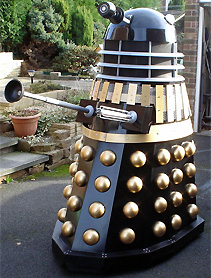
 
  
Far too much has been written about the real or perceived weaknesses of the daleks. I'm glad the new series made much of the fact that they can levitate and are no longer hampered by stairs (and just to pacify all you rampant Whovians, I do know that the first time a dalek floated up a flight of stairs was in an old Sylvester McCoy story, but few people saw it because by that stage the series had become acutely embarrassing and quite unwatchable). People also make jokes about the fact that daleks apparently have a sink-unblocking plunger as an unlikely weapon. Here again, we can thank the new series for showing us just how deadly that plunger can be. In episode six of the first new series we saw a man get his face suckered off by a dalek plunger. Very nasty.


Thus, another weakness of the daleks from Skaro was cleverly banished. But there's a third weakness that people don't talk about so often, because it's a little more lateral. And that particular weakness is the fact that the daleks feel the need to tell you exactly what they are doing, or plan to do, or have just done. My previous example of the dalek yelling, 'You will be ext-er-min-ated!' is a good one, straight from the original series. When daleks stalk their foe they inevitably scream 'You will ext-er-min-a-ted  or 'We will ann-i-hil-ate you!' Now, one of the hallmarks of being a good stalker/hunter is the ability to maintain silence, rather than let your foe know that you aren't far away. It's certainly inadvisable to yell, 'You will be ext-er-min-ated!' as this rather tips off your foe that they should get the hell out of there, and quickly. But daleks can't help themselves. Even when they are performing tasks that should really be blindingly obvious to other daleks, they are liable to announce, 'I have im-pris-oned the enemy!' or 'I have open-ed the door!' or even, somewhat notably, in one of the old black and white stories, 'I have fal-len in-to the sea!' But daleks are very loyal to their own kind. In response to a frankly self-evident remark like this, they would never squawk, 'It's bleed-ing ob-vious that you have fal-len in-to the sea, you id-i-ot. I suppose you want us to res-cue you?' (Another fatuous but typically dalek-like remark.)
In this respect, daleks remind me of a particularly annoying kind of facebooker - you know the type, they feel the need to tell us exactly what they are doing every moment of the day, dalek-fashion. For example, 'I have just made a flour-less or-ange cake.' Big deal! What really surprises me is that there are always dozens of other Facebook daleks who respond to such trivial news with comments like, 'You are very clev-er to make a flour-less or-ange cake. I wish I could make a flour-less or-ange cake too.' or 'I would like to eat your flour-less or-ange cake.' You get the idea. Weirdly, it seems to be fantasy authors who are best at writing these inessential dalek-like comments. Maybe their minds are so full of fantastic incident, that they lose track of what is important and what isn't. And yet, the fantasy writers are the ones who have a go at us other writers for being dull because we write books about everyday people to whom bad things happen. (Which is kind of how stories work, even if there aren't vast armies of sword-wielding Betegeusian Farrkensnoggs to heighten the action.)

Friday, October 28, 2011

SIster Madge and the Daleks


One of the more delightful projects on which I'm working at the moment - and which nicely suits my meditative stroke-recovery state  - is a reissue of the big 'yellow cover' version of Sister Madge's Book of Nuns. It seems that quite a few adults nurse fond memories of the original hardback book, and secondhand copies have been receiving impressive bids on eBay. llustrator Craig Smith has done some lovely extra artwork and I have written two additional verse stories, one of which describes how The Convent of Our Lady of Immense Proportions came to be.

Here is an old article from Magpies magazine, which was unearthed by Lauris Pandolfini at the Booked Out Speakers' Agency. Thanks, Lauris. The article gives a synopsis of the correspondence that publisher Jane Covernton and I enjoyed during the creation of the first book.


Now that we are releasing a new edition it's possible to fix up some of the things in the original that aren't quite right. But should we bother? Here is the first verse of the introductory rhyme in the yellow book:

Convents are religious places
Peaceful and serene,
Nuns go there to say their graces
(Prayers are what I mean)
Through the arches dark and lofty,
Round the sacred tree,
All the nuns are treading softly -
All except for me.

Now, this really makes no sense. Nobody says 'graces', they say 'grace', and it's a cheat to say 'Prayers are what I mean'. As for 'the sacred tree' , more about that in a moment. So I can now fix this verse, which I admit is fairly wobbly. But some people, who learned the rhymes when they were in school, are perfectly happy to keep 'the sacred tree'. They've already rationalised in their minds that the convent should have its very own 'sacred tree' and are rather fond of the image of nuns walking around it, while saying their 'graces'. Originally, the line was to be 'Round the sacristy' - which actually does make sense because, as good Catholics know, it's a room in a church where all the religious props are stored - the hymnbooks, the bibles, the collection bowl, the communion wine, the hosts, choirboys, etc, but not many young readers would know this. More importantly, most would not know how to pronounce it, so sacristy became 'sacred tree'. I probably should have left it alone, but The Sacred Tree bothers me - which is why I changed it in the new edition:

Convents are religious places
Peaceful and sublime
Full of nuns with solemn faces
Praying all the time.
Through the arches dark and lofty
Meek as they can be
All the nuns are treading softly -
All except for me.


Time for a dalek, I think:


I've been watching some of the old Doctor Who DVD's recently, and I notice that a few of the early stories have been reissued with new digital special effects. The Day of the Daleks is a wonderful story that I remember seeing when it was first aired on the ABC. The story's climax features a battle between humans and an 'army' of daleks in the grounds of an English mansion. I recall clearly that there were only three dalek props constructed for the story, so the 'army' consisted of the same three daleks being shot from several different angles, to give the impression that there was a mighty dalek army. I don't think that any kids would have been fooled by the ruse, but I really don't think it mattered - young viewers were prepared to suspend disbelief. As far as we were concerned, there really was a whacking great dalek army - even through we saw only glimpses of very small parts of it. It helped that the story was clever. In order to prevent a third world war, guerillas from the future go back in gtime and try to destroy the man, Sir Reginald Styles, who purportedly sabotaged a vital global peace meeting by murdering the delegates in an explosion, thus bringing WW3 upon the planet. But in trying to eiliminate Styles, the guerillas from the future (an altrenative 22nd Century) unintentionally cause the explosion themselves - in other words, they are going back in time to prevent an event that they made happen. This idea is so hard to get your head around (and like all time-paradox stories, it does have holes) that you really don't worry about the fact that the mighty dalek army seems rather under-sresourced. But it obviously bothered some people, because a lot of money was later spent on adding extra daleks and dubbing on new dalek voices, because apparently the original ones were rubbish. (I certainly never notived that). I suppose if a dalek is screaming 'Exterminate!' and happily blasting away, the tone of voice it uses is probably the last thing you worry about- unless, of course that voice is very wrong. If Gretel Killeen had voiced the daleks in her best Telstra recorded message voice, even kids would probably twig that something was amiss.

The new improved version of Doctor Who and the Day of the  Daleks (More daleks! New voices!) is great stuff, but we probably could have done without it. And did we really need George Lucas to add some extra stuff to A New Hope, the first Star Wars movie he made? The South Park guys obviously didn't think so,and devoted a whole episode of their terrific show to pointing out why it was  a bad idea.

(Okay, comparisons are odious. I'm not putting Sister Madge on the same level as daleks and C3PO. )


So maybe the mistakes that I see in the first Sister Madge book aren't quite so blinding, and should be left as they are. (Some critics complained that the scansion wasn't consistent. That's quite true, it wasn't, but that might not be such a bad thing, and anyway, critics who write about verse books love to throw in words like 'scansion' to prove how erudite they are, even though they usually have no ear whatever for rhythm themselves. 'Scansion' for those who are interested, and I'm sure there aren't many of you, means the meter or rhythm of a verse. As for the meter of Sister Madge's Book of Nuns, it's known as 'trochaic tetrameter'. You definitely didn't want to know that.)

I seriously considered adding one more poem - but won’t, since it is such a departure from the original. But as a blog bonus, here it is:

As you wander through these pages
Full of things composed by me
Though they’re full of rhyme and rhythm -
Never call them poetry.

Poetry is wise and witty,
Sometimes long and sometimes short,
Full of feeling and emotion
Words of beauty, words of thought.

In these pages you’ll discover
Writing of a different kind:
Several stupid situations
Told in words that aren’t refined.

Read them slowly, read them quickly,
Shout them loudly as can be,
Read them any way you like, but –
Never call them poetry.

The sole reason I wanted to include this, which should be pretty self-evident, is that I'm a little uncomfortable about referring to the Sister Madge rhymes as 'poetry'. They are verse, maybe even doggerel, (Terry Jones, from the Monty Python team is quite happy to refer to his rhymes as doggerel, even though the word has unpleasant connotations.) If it's good enough for Terry Jones, it's good enough for me.


The Curse of the Vampire's Socks and Other Doggerel by Terry Jones.


The nun verses, unlike some doggerel, have strict tempo and rhyme. They're quite hard to write but fun to speak out loud. Kids who attempt to write this stuff are often prepared to sacrifice meaning for rhyme because they think the rhymes are more important. The results are usually terrible, the kids get discouraged and never want to tackle verse-writing again. I think it's a big mistake to do a lesson in class where the kids are expected to write their own verses. In fact, if I were a teacher I would never set 'verse-writing' as a classroom activity - because the kids who like it will do it themselves anyway. I think the best way to impart the fun of verse is to recite it, just as Mum and Dad used to recite the Dr Suess verses to us. Who could forget The Sneetches? (I wonder if the good Dr Suess ever messed round with his work once the first edition was published. Probably not.)

Monday, October 24, 2011

Cocky in the Brain


Hello there. I haven't posted for a while because recovering from stroke slows down your entire life. Even though I do rehab exercises every day, my rehab team keeps reminding me that it will most likely take six months for me to recover fully. (Even typing this post is amazingly difficult.) Kind people who have come to visit seem surprised that I don't look like Lon Chaney Senior playing Quasimodo. Shouldn't stroke victims be all dribbly, with one side of their face drooping? This is pretty much society's preconception. My face looks symmetrical at the moment, but then I've been exercising it every day, trying to rediscover how to lift my soft palate. There are perfectly good muscles on the left side of my face but my brain has merely forgotten they are there. There's a trick where we remind the brain of these muscles by placing an icepack on them. Suddenly the brain senses something. 'Oh, that's right, there are muscles there, so I might as well use them.' I can now walk without tripping over, because I've been practising balancing. Standing on one leg and closing your eyes might not seem that difficult, but I still can't do it. Balance exercises take up an hour of each day.


I suppose I do appear quite chipper for a stroke victim. I can even run - though I've found only one place where it's safe enough to do this. There's a park alongside the commission flats in Prahran. It's a concave shape and the grass is quite long and tufty- giving me a soft landing surface should I trip. The treat of the week is to go to this park and run its diameter two or three times. It feels so good to run and leave the stroke-stricken version of me behind.

I had the stroke on 7 September (I’m a little hazy on dates, my short-term memory is still bad) which means I'm in the middle of that vital three month recovery period, where everything I do now will have the strongest impact upon how completely I recover from this thing, so I’m working hard on my rehab. Try standing on one leg and squatting. Not so easy, is it? Now try it eight times in a row, three times a day.

So I'm looking relatively 'normal', but it's what's going on inside that worries me. I don't seem to have recovered the mental faculties that enable me to write TV scripts and books. Even my Final Draft software is hard to negotiate. I very much want to write a sequel to my book, The Life of a Teenage Body-snatcher, but I'll have to read it again because I forget the characters and story.

 
I'm overemotional. They warned me that I would be, but I was taken by surprise when I found myself weeping at the end of Shrek 3 - and it wasn't because I'd just wasted my money on seeing a movie that should probably have been better, given the many resources at Dreamworks' disposal. I was also aggrieved when I read on Megan Burke's blog the following teen reviews of The Life of a Teenage Body-snatcher. This is a précis:)

Virginia said:
The book was quite good but a bit boring at times. Some of the humore wasnt very funny -_- , But it was a goodish book but LOTS of room for improvement .

Rabid said:
boring not enough gore

Samantha said:
Fairly good book i guess but not really my type of book. The jokes should be more understandable


It's rare of me to self-google. It was an ill-advised attempt to get a bead on the first book, to try to find out what people liked about it (I really should know this already, but the memory has gone).


Megan explained to me that these emails all arrived at the same time and had an edu. suffix, so it's pretty likely that some poor teacher had been given the task of 'teaching' the book, but rather than read the teacher's notes or look too deeply into the novel in order to answer questions from the students, they have taken advantage of Megan's better nature and directed the students to send their comments to Megan, since she is known for dilligently replying to all comments she receives, and she's astute. This normally wouldn't and shouldn’t bother me. But it did, and I'm very happy to say that Megan as moderator declined to publish my response to the slew of critiques from young readers. I even think I had a go at Samantha, suggesting that just because she's too dumb to get the jokes, doesn't mean that other readers are. But Virginia was the one who really got to me with her 'LOTS of room for improvement'. Each one of those uppercase letters stings. I feel like I've been reprimanded by Mr Atkins  (a much disliked schoolteacher character from the book).


In 2010 I wrote a novel called The Shiny Guys. I had to copy-edit it last week, alongside my editor, Dmetri, and I found that I no longer loved the book. It's very dark, with hardly any jokes, so at least Samantha should be relieved.


I'm sure my sudden ambivalence toward the book is a result of the stroke. (UPDATE 29 October: I now like the book. Wait till you see the cover!) So the very last thing I should be doing is paying heed to the pulings of readers who didn't exactly 'ship' my last work.


Here is something funny. I daresay that even Samantha might be able to understand it. In The Shiny Guys, the villains resemble cockroaches. (They are the sole survivors of a nuclear war.) Now, look very closely at this MRI below. It's my brain just after the stroke. You'll note there appears to be an evil grinning'Jack o'lantern face in those dark areas of my brain. But there is something else. Have a good look now at the space between the Jack o'Lantern eyes. Remind you of anything? It's a cockroach. I obviously had cockroaches in my brain when I wrote The Shiny Guys.


Well-meaning stroke comment number one:

'You'll be fine. My grandpa had a stroke. He spent six months in hospital, but when he came out he was sharper than ever. And he didn't lose his sense of humour, which I know you're very concerned about. He came to my cousin's birthday and got big laughs when he said 'Pull my finger,' then farted.  Same old Grandpa! Unfortunately, he shat himself as well.  Mind you, that used to happen even before the stroke.'


Sunday, October 2, 2011

Different strokes


Last year, my partner and I took an old friend, Denis, to a birthday lunch at Mirka's in Fitzroy Steet, St Kilda. We shared a bottle of red. At the end of the meal, Denis was having difficulty standing up, despite the fact that he had consumed little wine. We had to help him out the door. He was speaking clearly and felt no pain, but he simply couldn't stand up. We took him straight to his doctor, who diagnosed a stroke. We felt stupid for not realising what had happened, and drove Denis straight to the Epworth hospital in Richmond. We were still within that 'four hour safety zone' where, if the stroke is due to a blood clot it is possible to administer some form of miracle drug that clears the clot before there is any major destruction of brain cells due to blood starvation (this is apparently quite wrong and I would welcome any corrections from readers, along with your stroke jokes). Denis had a cerebral haomorrhage and there is no 'miracle cure' for that. So we waited with him in triage, until he was admitted. I thought it extraordinary that Denis could have a stroke without noticing the precise moment, as it were. There was no pain, no headache. And that's the thing about strokes, they sort of creep up on you. And you don't even realise you've had a stroke until you attempt to walk or speak, only to find that you can't. Very early on the morning of 6th September, I had my own stroke. My lips felt numb and my fingertips tingled. They were the only two symptoms and I figured I'd had some mild form of attack, something like indigestion; nothing as ominous as a stroke. (By the way, strokes aren't truly ominous, it's just that we have come to think about them that way. My agent was concerned that I might require brain surgery and even a stent inserted into my brain. And yet one in four people is likely to suffer a stroke and almost all recover completely.)
  This is not my brain.

SO, here's the educational part. Are you sitting comfortably? A stroke occurs when blood flow to the brain is interrupted, the first case being that the wall of a blood vessel bursts, allowing blood to leak to the brain. This stops the delivery of oxygen into the brain, causing cells to die. About fifteen percent of all strokes are haemorrhagic strokes, where blood leaks into the the brain. An aschaemic stroke (which is what I have just experienced) is more common. In this case, a clot blocks a blood vessel that is too narrow for it to pass through, and the brain is again starved of oxygen. The brain cells in the immediate area that die are known as an infarct. (A gift to comedy. And there are no shortage of stroke jokes - which is fine by me. Mel Brookes once said he was working on a sequel To a famous sitcom where the principal character suffersS a stroke. According toO Brookes, the show was to be called Half of Father Knows Best. I laughed when I heard that, just as I laughed at the start of the movie The Player, where seomone - I think it was Buck Henry - pitches to studio execs a sequel to The Graduate, where Mrs Robinson has just sufferred a stroke. And JAck BLack was pretty funny in High Fidelity when he expressed his concern to a customer who wanted to buy I Just Called to Say I Love You for his teenage daughter: 'Oh my god, did she have a stroke? Is she in a coma?' Bring on the stroke jokes, I say. Take the mozz off it.

People considered high risk for stroke are those with high blood pressure (that would be me) diabetics (that wouldn't) the obese and unfit (pass) smokers (gave up years ago) those under stress (I don't consider myself stressed. I figure I'm fairly laid back but no one else does).

This is my brain.


Denis recovered from his stroke, and I am currently recovering from mine. I have regular physiotherapy, the main aim of which is to restore my sense of balance, and also speech therapy. The muscles down the left side of my face don't work (or rather, they do but my brain has forgotten that), my lip droops and my soft palate won't lift. This means that a lot of things I say come out of my nose. I'd make a great ventriloquist, but my dolly would sound like Julia Gillard.

The incredible Doug MacLeod and Julia.

One of the side-effects is that my long-term memory is now very good, but I have difficulty remembering what day of the week it is. When doctors and nurses asked me for my home address, I kept telling them that I lived in Eltham - which I did, twenty years ago. For some reason I also know quite a bit of German, a language I studied briefly and wihout much success, when I was a teen. (According to my mother, a nurse, there is scientific evidence of this happening before. So, apparently strokes can bring out the German in you. Who knew? I m now ensconced in St Kilda - not Eltham- where I am trying to trick my brain into rewiring itself, so I can continue to write and make a living. I still sound a bit weird when I speak, as though I have just downed a litre of brandy. This morning I unintentionally scared away a beggar in Coles Carpark in Acland Street. He approached me and remarked that it was a beautiful morning. Eager to show off my newly regained vocal ability, I agreed with him, and added a few trenchant observations about the cloudscape. I might even have told him that I have it on good authority that the rain in Spain falls mainly on the plain. He ran. Despite scaring the occasional vagant, I think I'm coming through it okay, though this blog is taking me forever to type and I'm aware that it's full of typos and spectacularly dull. I'll keep you posted on any progress, and whether the ventriloquism career takes off. What I really want to do is write a sequel to The Life of a Teenage Body-snatcher, since that's the first book I've ever written where I actually made back the advance that Penguin paid me.

Here is someone who can put this all much better than I can, and indeed has made a fortune out of her stroke. Good on Dr Jill Bolte Taylor. You get lemons, so you make lemonade.


Saturday, August 20, 2011

Cover Story

'I haven't read your novels - I did see a couple but the covers put me off.'

I'm not going to tell you who wrote that about me because she's terrifically important and anyway it was in an email, which sort of counts as being off the record. But Dyan makes a very valid point. I'm never going to read a book with a pastel cover featuring a martini, a handbag and a pair of stiletto-heeled shoes. And yet, you'll see thousands of books like this, so obviously someone is reading them. So of course the cover is important. Jaws wouldn't have sold anywhere near as well if the shark had been done by Anne Geddes.

I've been lucky. I've liked all my covers. In the case of The Life of a Teenage Body-snatcher, the artist who was originally contracted to do the job became unwell and couldn't do the work. He was very apologetic and we were sympathetic, even though we were also tearing our hair out. Then Penguin designer Karen Trump (now Karen Scott) recalled seeing the work of an artist, Polina Outkina. I hadn't heard of Polina, but she seemed almost too romantic to be true. She was born into a family of jewellers in an ancient Russian city called Yaroslavl. She is a keen violinist. Even her name is perfect. Polina Outkina. And when I saw some of her work online I was even more enthusiastic. How's this for starters?

I was confident that we had found exactly the right person to do the cover for a dark comedy about certain unpleasant goings-on in England in 1828. But could Polina do it in time? A matter of days after Polina was briefed, Karen received this piece of rough cover art from Polina's studio in New Zealand.


We all jumped for joy because this was even better than we'd hoped. Karen gave Polina a few minor notes and the final art appeared shortly afterwards. Below is Polina's artwork for the front and back cover. Beneath it is the very final version with Karen's extra design touches. 
 
 
And now, thanks to the generosity of The Children's Book Council of Australia, the cover has a medal on it. Actually, I stuck this one on myself because the reprint hasn't happened yet. I believe that if and when it does, the medal will be rather less obtrusive, which is a good thing because you'll be able to see more of Polina's artwork.


Friday, August 12, 2011

A summary of the post about judging that I accidentally deleted, which is possibly why I'm feeling hostile towards computers at the moment.


Deleting is all too easy on a computer, as I discovered when I deleted my second from last blog post. This annoyed me because it was actually a pretty good post, about the nature of literary competitions. I'd just had the experience of being one of three literary judges. The piece of writing that I thought deserved to win was eventually voted down by my peers. They agreed that what I had chosen was certainly a good effort, but it wasn't prize-winning material. Not in their opinion anyway. And they were both professional writers with some seriously impressive credentials, so who was I to argue? I was a writer too, damn it, and I argued for quite some time, pointing out that the piece I had chosen had a very clever premise and didn't put a foot wrong, producing a funny, satisfying plot that built to a strong conclusion. They said yes, but not quite.

If you think the other two judges discounted my choice because comic writing is often given less consideration than other forms of writing, you'd be wrong. The piece that they chose, and which went on to win the award, was another comedy. We had plenty of serious stories, and a lot of them were good. We read them all twice, with a gap between each reading, just in case our moods might have changed, and what we thought was a stinker might in fact have been a searing indictment of the world in which we live. Even I thought that the winning piece was funny. I just didn't think it was as good as the piece that I had chosen. One of the other judges pointed out that the story I favoured covered ground that other writers had covered before. But was this really a problem? Should we discount a story about madness because Sylvia Plath has already done a pretty good book on the subject? I sulked. Because we judges have to remain anonymous, I would never get the opportunity to tell the writer that I thought his/her work deserved a prize. And honourable mentions weren't allowed. So this poor writer, who really did write a very good piece, now believes that the judges thought his/her work was crap.

Okay, so that's the gist of the blog post that I lost. It was much better than this outpouring, of course, because I took the trouble to introduce suspense into the proceedings. I described the various rounds in which entries were eliminated, the attempts to resolve the final stalemate by preferential voting. The betrayal I felt when one of the judges switched from my team to the other side. I went to a little effort because I wanted to let authors know that just because you didn't win the glittering prize doesn't mean your work isn't good. In fact, it doesn't even mean that your work isn't worthy of an award. There's a chance that, in the opinion of one of the judges at least, your work should have won. I wrote this post not only as a judge, but also as someone who has been writing YA novels for nearly ten years and who has only just started appearing on shortlists. Time for a photo. I've been nominated for The Victorian Premier's Literary Award in the young adult fiction category. Three of us are up for it: Cath Crowley, Cassandra Golds and yours truly. Here are Cath and I at the launch, with poet Libby Hart and author Craig Sherborne. The guy next to me is Premier Ted Baillieu and he's awfully tall, but I'm standing on a step.


It's gratifying to make a shortlist and it hurts when you don't. James Roy, who is a good writer, blogged about this candidly, when this year's CBCA shortlists were announced. But James, there may well have been a judge who thought your work was head and shoulders above the rest, but who was outvoted. And that judge probably sulked as much as I did when I couldn't give the prize to the writer that I thought most deserving.


Digital Editing

The title of my next post is rather prolix, so I decided to keep this title short and sweet.

For the first time in my life I've worked with my editor on an electronic edit of a manuscript. This is the way Penguin does it now. You no longer get a lovely pile of A4 pages covered in pencil marks where your editor has come up with suggestions, corrections, even the odd jokey remark, always encircled so that the setter knows this particular remark is not to see print. My new book is around sixty thousand words long. Even though I've already done six drafts of it, it still isn't quite there. This is the time that the editor and I work together to see if we can actually achieve 'thereness'. When you work with an editor like Dmetri Kakmi, who has done all my books for Penguin, you end up pushing the words around quite a bit. Whole pages sometimes go, and you have to come up with new ones. In the case of my last book, The Life of a Teenage Body-snatcher, the two last chapters appeared very late in the piece, when Dmetri finally succeeded in convincing me that my book had a dud ending. It wasn't enough to have my mysterious adult body-snatcher appear at a public party. Oh no. It had to be more interesting. So I came up with two extra chapters that involve quite a lot of running and fainting and weapons and a daring rescue at sea. (Not everyone is satisfied by this ending, but I am. Especially the daring rescue bit.)

Here is page six of The Life of a Teenage Body-snatcher, the way it looked when Dmetri and I had finished copy-editing. Click on it to enlarge if you want to see how much to-ing and fro-ing goes on between editor and writer:

Some authors might be uncomfortable with copy editing of this extent. Certainly, Dmetri rarely gives a light edit, but his judgment is good and I like the way he challenges me. When Penguin designer Karen Trump (now Karen Scott) saw the amount of copy editing that Dmetri and I did on the typescript of one of my earlier books, The Clockwork Forest, she advised the typesetter not to bother using the electronic copy of the text that they had been sent. Typesetters almost always work from these. But there were so many changes, Karen suggested that the typesetter might as well set the whole thing from scratch. She may well have been right. She's been right about the design and covers of all my books so far. But in this digital age, the typesetter probably wasn't used to working from scratch, and some remarkable misprints appeared at first pages. The hero of The Clockwork Forest is named Morton, though his name was rendered as Moron once or twice. It made me pay particular attention to the proof-reading, and I'm fairly confident that there isn't a single goof in the whole of The Clockwork Forest. I wish I could say the same about The Life of a Teenage Body-snatcher, but I was over-confident and eight misprints slipped through. Nevre mind.

My new book is called The Shiny Guys. It's fairly serious because I didn't feel like being funny. It's my first experience of computer editing, and I didn't especially enjoy it. Dmetri asked all the right questions and suggested what I should delete and rewrite to improve the book. But I missed his little encircled comments in the margins. (You can still make comments with Word's editing program, but it's a bit like Twitter. It demands brevity.) I also missed those beautiful symbols that all editors and authors know, the ones that mean delete, transpose, carry over, etc. Here is a page from The Shiny Guys, edited by Dmetri and me. For continuity, I'll include page six. Once again, click if you want to enlarge:


It looks pretty bland, doesn't it? Computer editing is faster, cleaner and more efficient than the old fashioned kind. That's what they tell us, anyway. But I haven't taken to it. Maybe it's because I'm now in my fifties and resistant to change.  Back in the old days, when technological advances meant that printers no longer had to put together line after line of lead letters, maybe I would have been the one shaking my head and insisting that lead letters were far superior to this new-fangled nonsense. But I think my resistance to digital editing is that I miss the close relationship between editor and author, where you can have lively marginal debates about what should stay, what should go and what should be rewritten. Technically, you can do that with Word. But the program really doesn't encourage it.

I moaned about the digital editing revolution to fellow scribe Cath Crowley. How did she enjoy editing on a computer? She said, with some relief I think, that Pan Macmillan hadn't asked her to. Graffiti Moon was edited the old-fashioned way, with a pencil, and Cath was confident her next book would be too. I know that Morris Gleitzman prefers to have his manuscript go straight to first pages. That is, the copy editing doesn't happen until the first set of pages comes back from the typesetter. Everyone has a preference. Maybe I'll get used to it. But I can't help thinking that digital editing may make us lazier. It is a quick way to edit. But with speed comes slipshoddery, a word to which Jonathan Shaw introduced me, so I'm going to leave it, even though spellcheck desperately wants me to type something else.

The Shiny Guys will be published by Penguin in the first half of next year. It will have a brilliant cover, because Karen is working on it again. It will have less misprints than The Life of a Teenage Body-snatcher. Just in case Dmetri thinks I'm having a go, I should point out that the errors were mine. After the first print run, we noticed the mistakes and had them all fixed in the reprint. Then the book was shortlisted by the CBCA, so we had a second, bigger reprint. But McPherson's used the wrong film. So even though the book now has a nice medal on the cover, it also has eight misprints once again. I'm really sorry about the one on page 241. Click to enlarge and see if you can spot it:


And now to liven up what, visually at least, is a fairly bland post, here is my brilliant editor in his old office at Penguin Books in Camberwell. The more astute of you will notice that Dmetri is wearing a large bunny rabbit head. I don't know where he found it. But he decided to wear it at work one day, and the moment has been captured for posterity. Dmetri is now a freelance editor, and sharper than ever. I don't know if he still has the large bunny rabbit head. But I'm sure the Penguin people miss him.