Friday, August 12, 2011

Digital Editing

The title of my next post is rather prolix, so I decided to keep this title short and sweet.

For the first time in my life I've worked with my editor on an electronic edit of a manuscript. This is the way Penguin does it now. You no longer get a lovely pile of A4 pages covered in pencil marks where your editor has come up with suggestions, corrections, even the odd jokey remark, always encircled so that the setter knows this particular remark is not to see print. My new book is around sixty thousand words long. Even though I've already done six drafts of it, it still isn't quite there. This is the time that the editor and I work together to see if we can actually achieve 'thereness'. When you work with an editor like Dmetri Kakmi, who has done all my books for Penguin, you end up pushing the words around quite a bit. Whole pages sometimes go, and you have to come up with new ones. In the case of my last book, The Life of a Teenage Body-snatcher, the two last chapters appeared very late in the piece, when Dmetri finally succeeded in convincing me that my book had a dud ending. It wasn't enough to have my mysterious adult body-snatcher appear at a public party. Oh no. It had to be more interesting. So I came up with two extra chapters that involve quite a lot of running and fainting and weapons and a daring rescue at sea. (Not everyone is satisfied by this ending, but I am. Especially the daring rescue bit.)

Here is page six of The Life of a Teenage Body-snatcher, the way it looked when Dmetri and I had finished copy-editing. Click on it to enlarge if you want to see how much to-ing and fro-ing goes on between editor and writer:

Some authors might be uncomfortable with copy editing of this extent. Certainly, Dmetri rarely gives a light edit, but his judgment is good and I like the way he challenges me. When Penguin designer Karen Trump (now Karen Scott) saw the amount of copy editing that Dmetri and I did on the typescript of one of my earlier books, The Clockwork Forest, she advised the typesetter not to bother using the electronic copy of the text that they had been sent. Typesetters almost always work from these. But there were so many changes, Karen suggested that the typesetter might as well set the whole thing from scratch. She may well have been right. She's been right about the design and covers of all my books so far. But in this digital age, the typesetter probably wasn't used to working from scratch, and some remarkable misprints appeared at first pages. The hero of The Clockwork Forest is named Morton, though his name was rendered as Moron once or twice. It made me pay particular attention to the proof-reading, and I'm fairly confident that there isn't a single goof in the whole of The Clockwork Forest. I wish I could say the same about The Life of a Teenage Body-snatcher, but I was over-confident and eight misprints slipped through. Nevre mind.

My new book is called The Shiny Guys. It's fairly serious because I didn't feel like being funny. It's my first experience of computer editing, and I didn't especially enjoy it. Dmetri asked all the right questions and suggested what I should delete and rewrite to improve the book. But I missed his little encircled comments in the margins. (You can still make comments with Word's editing program, but it's a bit like Twitter. It demands brevity.) I also missed those beautiful symbols that all editors and authors know, the ones that mean delete, transpose, carry over, etc. Here is a page from The Shiny Guys, edited by Dmetri and me. For continuity, I'll include page six. Once again, click if you want to enlarge:


It looks pretty bland, doesn't it? Computer editing is faster, cleaner and more efficient than the old fashioned kind. That's what they tell us, anyway. But I haven't taken to it. Maybe it's because I'm now in my fifties and resistant to change.  Back in the old days, when technological advances meant that printers no longer had to put together line after line of lead letters, maybe I would have been the one shaking my head and insisting that lead letters were far superior to this new-fangled nonsense. But I think my resistance to digital editing is that I miss the close relationship between editor and author, where you can have lively marginal debates about what should stay, what should go and what should be rewritten. Technically, you can do that with Word. But the program really doesn't encourage it.

I moaned about the digital editing revolution to fellow scribe Cath Crowley. How did she enjoy editing on a computer? She said, with some relief I think, that Pan Macmillan hadn't asked her to. Graffiti Moon was edited the old-fashioned way, with a pencil, and Cath was confident her next book would be too. I know that Morris Gleitzman prefers to have his manuscript go straight to first pages. That is, the copy editing doesn't happen until the first set of pages comes back from the typesetter. Everyone has a preference. Maybe I'll get used to it. But I can't help thinking that digital editing may make us lazier. It is a quick way to edit. But with speed comes slipshoddery, a word to which Jonathan Shaw introduced me, so I'm going to leave it, even though spellcheck desperately wants me to type something else.

The Shiny Guys will be published by Penguin in the first half of next year. It will have a brilliant cover, because Karen is working on it again. It will have less misprints than The Life of a Teenage Body-snatcher. Just in case Dmetri thinks I'm having a go, I should point out that the errors were mine. After the first print run, we noticed the mistakes and had them all fixed in the reprint. Then the book was shortlisted by the CBCA, so we had a second, bigger reprint. But McPherson's used the wrong film. So even though the book now has a nice medal on the cover, it also has eight misprints once again. I'm really sorry about the one on page 241. Click to enlarge and see if you can spot it:


And now to liven up what, visually at least, is a fairly bland post, here is my brilliant editor in his old office at Penguin Books in Camberwell. The more astute of you will notice that Dmetri is wearing a large bunny rabbit head. I don't know where he found it. But he decided to wear it at work one day, and the moment has been captured for posterity. Dmetri is now a freelance editor, and sharper than ever. I don't know if he still has the large bunny rabbit head. But I'm sure the Penguin people miss him.


Saturday, July 9, 2011

The Jigsaw Factory (with updates, 12 August)

The Jigsaw Factory. (Thanks to Sonia Kretschmar for finding some of the photos that appear in this post.)

In 1971, a remarkable shop/design studio/theatre space appeared on Bridge Road, Richmond, near the bridge. I think it was a converted rubber factory, though I may be wrong and I can't find anything on the net. I also can't be certain how many storeys the building had, but I think it was four. When you're a kid, things look bigger. Maybe it was only three. Last time I saw it was when I was thirteen, which is about forty years ago.

It was called The Jigsaw Factory. The bottom floor was the 'shop' part, but it was like no other toyshop you've seen. The place was like a garden of delights, where both kids and adults were encouraged to play. There was a big sunken toy pit designed in the shape of a giant called Og.

Og's playpit.

There was a big ostrich called Oliver. He appeared in many guises, including a display stand. There was definitely a bridge, but I can't remember if it was in the shape of a crocodile or something else. There were wooden cubby-houses, giant snakes and some very hip beanbags.

Oliver the ostrich.

Above the shop were craft rooms where kids could learn pottery or enameling. (I burned my finger at one of the enameling classes and it was most definitely my fault.) There was even a little theatre where kids' shows were performed, and Bruce Woodley from The Seekers would come in to sing on Sunday afternoons. Plays for kids, written by Lorna and Bill Hannan, were staged there. The Jigsaw Factory was a riot of colour, with purples, yellows and greens wherever you looked. James Button, in an article in The Age in November 2002 described it as a 'Disney-free magic kingdom for children'. I can't do any better than that.

But the best thing about The Jigsaw Factory was that you could take parts of it home with you, in the form of toys, games, books and posters, which all looked exactly like the store. The board games came in wonderful big boxes that were bright yellow, blue and green. The aforementioned giant Og had three books about his adventures. You could either read one like a normal book, or let all the pages concertina out so that you had a frieze.

Og the Giant and Oliver the Ostrich enjoy a casual moment together on The Jigsaw Factory shop floor.

There were two other books I recall. One was A Dictionary of Magic, which included a set of beautifully designed 'Jigsaw' Tarot cards, and the other was a remarkable thing called From Zoetrope to Cinemascope. This book, a potted history of moving pictures, could actually be turned into a Zoetrope, by removing the stiff cardboard wheel that was a part of the cover, then slotting into it one of eight cardboard 'reels' that you could pull out from the centre of the book. Some of these reels were brand new mini-animations created by the designers (my dad was very impressed that one demonstrated how an internal combustion engine works), others were pop art versions of the old Eadwaerd Muybridge films from the end of the nineteenth century. There were no nude people walking and boxing, but there was the famous galloping horse. The book was ingenious, but I can't find a single reference to it on-line. As for the magic book, I wonder if today's gatekeepers would allow you to sell children's books containing decks of Tarot cards?


The most expensive of the boardgames was The Gate of the Sun, a stunning thing that had two separate boards, rings and cards featuring Oracles and Magi. That one was six bucks. I still have my copy.


The game Pirates was only two bucks fifty. I also bought that one. It was a good game too, with plenty of piracy for your money. North Face was even cheaper. it was a mountaineering game and it cost two bucks. Animator Frank Hellard devised this board game, played without dice. The games were hard to resist in those beautiful big boxes, with the distinctive Jigsaw logo.

Copies of Spellbound, waiting to be boxed up.  

The cheapest items were the Og goggles. For a dollar, you could get a set of ten cardboard spectacles with multicoloured Jigsaw designs. They were a much cooler party idea than stupid cone hats with elastic. There were badges too, with gently environmental messages such as 'Don't Spend the Earth' and 'I'm 100% Bio-degradable.'

Some of the games were educational, but inventively so. An educator called Dr Dexter Dunphy designed Spellbound and Tableland, games to teach kids about words and numbers. There were over forty different toys, all brand spanking new and never seen before. Sure, the shop stocked other toys as well - good ones by local manufacturers - but the ones you really wanted were the Jigsaw ones. So where did did they all come from?

Stitt and Weatherhead.

They were generally designed and devised by two graphic artists called Bruce Weatherhead and Alexander Stitt. Educators Bill and Lorna Hannan also gave them a hand. The top floor of the Jigsaw Factory building was where the artists did their wonderful work.

Messrs Stitt and Weatherhead at work.

Sadly, Bruce Weatherhead passed away in January, 2011. Mr Stitt is overseas, and I'm hoping that when he returns he'll be able to correct the mistakes I've made in this post, and help me remember more about The Jigsaw Factory. Weatherhead and Stitt joined their considerable forces in 1964, then dissolved the partnership ten years later. The Jigsaw Factory also came to an end. It was around for less than three years. It was too good to last. (Update 12 August: Alex and wife Paddy have since returned and been in contact. They have both compiled a lavish book called Stitt Autobiographics that covers fifty years of Alex's graphic design work. It's about three hundred pages long, published by Hardie Grant, and it's due for release in early September. The Jigsaw Factory features. The Factory was a wonderful but possibly over-optimistic project, even though there were many devoted fans. Alex sadly reports: 'When everyone lost enough money, we stopped.' Until very recently, the games Tableland and Spellbound were still being sold. Alex and Paddy were kind enough to contact me to do an informal launch of the book after the official one, presided over by Mr Philip Adams. But I had to declkine when I was discourteous enough to have a stroked. It too me three sessions of speech therapy just to be able to pronounce 'Al-ex-and-er Stitt.' The unofficial launch at Red Hill went very well, I'm told. And the book is a thing of great beauty. I'm including some page caps at the end of this blog, but for heaven's sake, buy the book. It's big, it's funny, it's shiny, insightful and even a bit educational - just like the old Jigsaw Factory itself.


Norm.

Bruce Weatherhead restarted the Melbourne Advertising and Design Club in 1983 and had huge success as a graphic designer. He was also a TV presenter in the USA for a short while. You can find out more about him here. Alex Stitt also continued his design career, inventing the famous 'Norm' character for Life: Be In It and Sid the Seagull for the Slip Slap Slop campaign. Based on the John Gardner novel, Grendel Grendel Grendel was an animated film scripted, designed, directed and produced by Stitt in 1981. It was years ahead of its time. So was his graphic novel, Person, Nipples and Fizzy O'Therapy. Journalist/critic/advertising guru Phillip Adams describes Stitt as 'a genius, the most under-recognised bloke in the country'. (Mr Adams will be launching Stitt Autobiographics at RMIT's Storey Hall, where he will no doubt say even more nice things.) 

Stitt started to produce a second animated movie in 1983. This one was called Abra Cadabra. Unfortunately, it was never finished. The film was an Adams/Packer production. According to Russell Bevers, Program Director at The School of Media and Communication, RMIT University, when Kerry Packer sold the Nine Network to Alan Bond, all completed work to date was shipped off to the new owner and never seen again. (Not quite. The film Abra Cadabra reappeared. Paddy Stitt thinks that the Bond organisation must have released it for telecasting in the United States at some stage, and there's a 35mm master in The National Film and Television archive in Canberra. The Australian Centre for The Moving Image in Melbourne also screened it four times in October 2008, as part of a special Kids' Flicks presentation. Until a nice remastered DVD of the movie appears, you can watch a copy of it here, posted by a fan. The picture and audio aren't great, but you get a taste.)

Some of the characters from the movie Abra Cadabra, which featured the voices of Jackie Weaver, John Farnham, Hayes Gordon, Gary Files and Hamish Hughes. Those last two actors provided some of the voices in Colin South's and my series Dogstar. For Dogstar, Gary played wayward genius, Ramon Ridley and got nominated for an AFI for his efforts - but enough about us.

Stitt's other achievements were about a hundred animated ads for The Christian Television Foundation, and a spectacularly cheeky party political animation that was commissioned by the Democratic Labor Party and duly aired, several times. Little did the DLP know that there was an ingenious visual joke in the cartoon that turned the whole thing on its head.

From The Swinburne Newsletter, 1980. Alex Stitt with graduate animation student Stephen French, who also went on to work for the Dogstar juggernaut.

Og the Giant and Oliver the Ostrich, the two Jigsaw Factory mascots, had their own comic strip in The Age newspaper, commencing in 1972 and ending in 1974. The stories for the strip were devised by Bill and Lorna Hannan and illustrated by Alex. They were unique in that each strip was like a frieze. There were no frames, as in most comic strips. I collected every single one. (According to Stitt Autobiographics, the only other person who appears to have done this is composer Bruce Smeaton.) The extraordinary thing about these strips was that, though they were supposed to be for kids and very few adults would have read them, they were deeply satirical. When the strip started, Australia had a Liberal government, and a Prime Minister called William McMahon. The government had been in power for more than twenty years. A charismatic opposition leader, Gough Whitlam, led the Labor Party to victory in December 1972. The whole campaign was paralleled neatly in the Og's daily cartoon strip - and hardly any adults noticed. Writers Bill and Lorna Hannan foretold the outcome of the 1972 federal election. The comic strip's story would have been ruined if Whitlam hadn't come to power. (South Park did the same thing years later, with a special Obama episode. Creators Parker and Stone conceded that if Obama hadn't won, they wouldn't have had an episode.)

Amazingly, Weatherhead and Stitt, and the estimable publisher John Curtain who later joined Penguin Australia, gave me a break when I was twelve. I kept sending them pictures and stories I'd written. I must have been one of the most annoying kids in the world. At the time I was living in Traralgon in the Latrobe Valley, so I was understandably attracted to a place that was so colourful and bright. The Jigsaw Factory people published my stuff in a monthly lift-out for kids that was published in The Age. My modest achievement has been suitably spun to suggest that I 'had my own monthly column in The Age when I was twelve'. I didn't really. I had a column within The Jigsaw Factory lift-out in The Age. Here's the third one, which I ended up using in my first book, Hippopotabus:


One of my columns from 1972.

The Jigsaw Factory people were a generous crowd who took the time to listen to newcomers with ideas.  They also gave a break to graphic artist Grant Gittus, who designed my website. Grant, like me, was published in the same monthly lift-out at twelve. After my first visit to The Jigsaw Factory's engine room, Alex did a picture of me playing a board game with Og the Giant. It's a game I invented, called Hang Fire. The Jigsaw Factory people were nice enough to sit down with me and play the game. The prototype could never have been produced, but they were kind to take the trouble.


I'm writing this because I hope there are others who remember the amazing place on Bridge Road. (Thanks to those who got back to me, including Alex, Paddy and graphic designer Ian James, who now works from Bruce Weatherhead's desk, and corrected me where I got things wrong.) It seems extraordinary that such creativity and talent doesn't appear to have been recorded that well. But graphic artist and animator Peter Viska, who was also a trailblazer with his regular Sunday Observer liftout, told me that Alexander Stitt will be releasing a book later in the year, featuring his work. (Paddy Stitt agreed that there wasn't much information available about Weatherhead and Stitt, The Jigsaw Factory, and a golden age of graphic design in Australia. Stitt Autobiographics addresses this, so we need not rely upon the cloudy memories of bloggers like me.)

I was a brat when I first entered The Jigsaw Factory's workroom on the third floor, desperate to be a part of this wonderful place. Bruce Weatherhead, Alexander Stitt and John Curtain (also sadly passed on) were generous, inspirational and deserve special points for not kicking me into Bridge Road. I write more about Alex here because he was the one who seemed to have the job of contacting me when I was writing stuff for Og's liftout in The Age. Most of the monthly liftout was written by the Hannans again, as well as writer Barry Breen, whose story in the first issue, The Bad Deeds Gang,  is way ahead of its time. Australian children's authors like Paul Jennings and Andy Griffiths would later write stories that revelled in childhood naughtiness. Actually, I wrote one or two myself. Bruce and John were every bit as friendly and welcoming as Alex, and their determination to create inventive books, posters, toys and 'funny surprises' for kids (as the TV ads promised) was very real. I'm sorry that The Jigsaw Factory came at personal cost to Alex and Bruce. It doesn't take away from the fact that, for a short while at least, there was a magical place on Bridge Road that really did impress and inspire a lot of kids and adults.

In the book, The Artist Craftsman in Australia, Alex and Bruce interview each other about The Jigsaw Factory and the philosophy that gave birth to it:


Until the book comes out (and you'll be amazed by how much of Alex's work has become a part of Australian culture) you'll find more information here
And here be a sneak preview of the book itself, in particular the Jigsaw material reprinted without permission, sorry Alex and Paddy. I'll take it down if you'd prefer. But I bet there are some grown-up kids out there like me with fond Jigsaw memories that were tickled by these pages:


  And here's the website, with plenty more fine pages, not necessarily jigsaw-related.

Thursday, June 23, 2011

How I joined The Comedy Company


In my teens and twenties, I was lucky enough to have a few children's books published. But the money really was extraordinarily bad unless you built up a huge backlist or wrote The Lord of the Rings, and it didn’t look like I was going to do either. I thought the way to make money would be to write comedy scripts for TV and radio. There was only one place in Melbourne at the time where you could study that, and that was The Victorian College of Arts. They accepted only a small number of students per year – thirty or so – and they wanted to make sure you’d be able to support yourself financially for those three years, so they asked you to write down how exactly you’d do this. Arrogantly I wrote down ‘royalties’ – which was a lie because there’s no way I could have supported myself on those alone, but that got me in.

Trying far too hard to be funny in a show I wrote at The Victorian College of Arts.

I graduated after three years, and wrote more kids' books that still didn’t make any money. But I now had this diploma that said I could write TV and radio scripts. So I also started sending comedy scripts away to TV and radio and in the end they started buying them. In the eighties, ABC Radio had a Comedy Unit that put together sketch programs to which I would contribute. I remember one was called Don't Get Off Your Bike. They paid quite well and the shows were highly produced. But ABC Radio eventually got rid of its Comedy Unit, which I thought was a pity. Then I got a weird break. One of the ABC producers thought I had a nice voice and she gave me a weekly radio show on ABC Radio National. It was called Rave. I’d come on after The Country Hour and before Baroque and Beyond. It was the first show on Radio National to feature comedy and rock music. It was also the last. But it gave me the opportunity to interview some of my comedy heroes, including Douglas Adams, Rowan Atkinson, Graham Chapman and Alexei Sayle. Since it went out live I also learned a golden rule of broadcasting, which is not to let a seriously drunk person on live radio. My interview with Ignatius Jones came to a sudden end when he fell off his chair.

After a Rave broadcast, with producer Debbie Richards. This is the only time Debbie Richards ever laughed at something I said. I wish I could remember what it was.

My real links with the Melbourne comedy scene happened as a result of Theatresports – the competitive improvisational drama game that became huge in the eighties and is still played in schools today. A lot of Theatresports is about panic. Back at the height of its popularity, you would be about to face an audience of two thousand people on some nights, and have no idea of what you were about to say or do. I was fortunate to be in a team that featured comedians Glenn Robbins and Maryanne Fahey, who weren't as fazed by it as I was. Though Glenn did vomit before one of the games.

During the first Melbourne Comedy Festival, a huge Theatresports event was staged at The Dallas Brooks Hall. Two thousand spectators watched my team, The Gutless Wonders, perform very badly. But I had one minor triumph. At a convenient moment, I discovered that I have a party trick that I'd never known about. I was very lanky back then, with loose ligaments. In one of the rounds we had to ad lib a short play about a murder in a computer games arcade. It wasn't going well. We were approaching the end of the game and nobody had been murdered. Then I got it into my head that the murder could be committed by one of the critters in an old fashioned Space Invaders game. So I tried to behave like one and it got this really big laugh and I had no idea why. The next night I saw myself on Channel Ten news, being a Space Invader. (Slow news day.) God, I looked freaky. The late great Peter Cook, who was the guest judge, decided that this performance was worthy of Moment of the Match, and he gave me the trophy. He did look puzzled when I got up on stage to collect it, and I suspect he might have got me confused with another player.

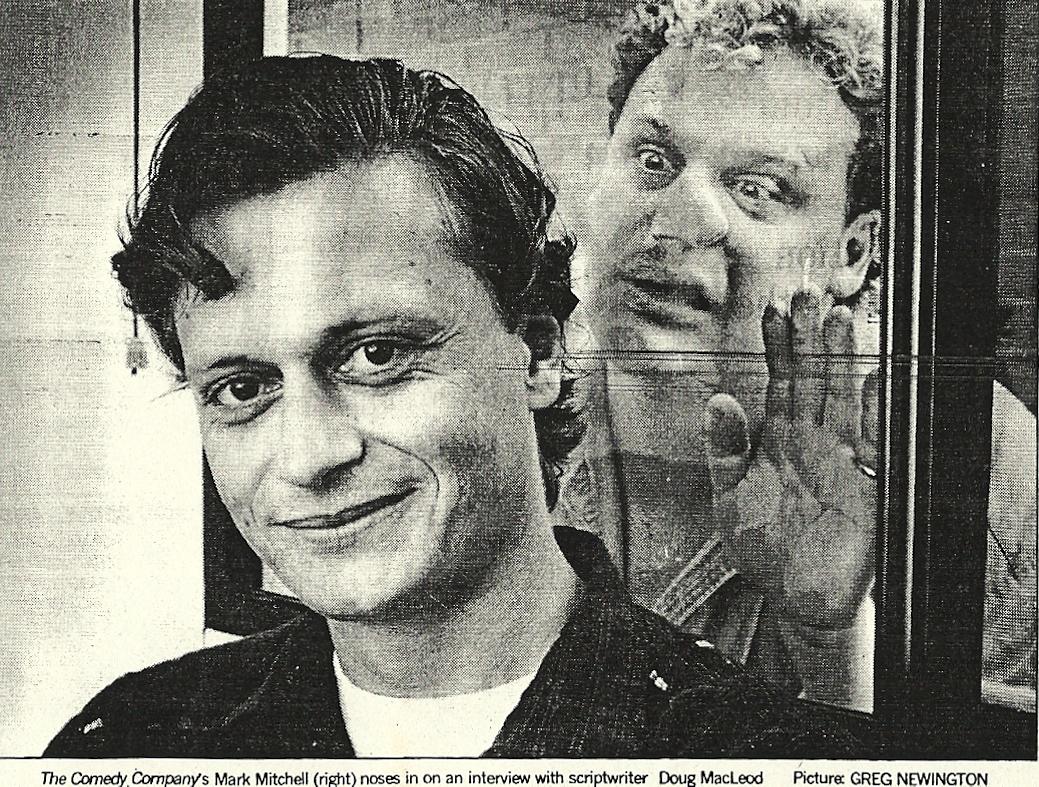
Trying to get a publicity shot without Mark Mitchell.

Out of Theatresports came my gig as head writer on the pilot of a TV sketch show called The Comedy Company for Channel Ten. It got picked up for a series of six, though it went on to run for two highly successful years and one unsuccessful one, and relaunched sketch comedy on commercial TV.

The first Comedy Company sketch I wrote was about a holiday resort where intellectuals went for meaningful relaxation. It was called Club Head (as opposed to Club Med) and it was a complete turkey. No one laughed. One of Glenn Robbins’ first sketches was Mum on the Run. It was a home delivery organisation that sent out these mums with plates of home-cooked meals – grey corned beef, bullet peas and Deb mashed potato – with rotund comedian Mark Mitchell dressed up like a mum emerging from a van. And Glenn’s stuff worked. People did laugh. As a seasoned stand-up comedian, Glenn knew that the real crowd-pleasing material was more to do with everyday stuff. He’d also trained as a teacher, so he had a fair idea about how kids thought, and it turned out that kids were a huge proportion of our audience.


Writers of The Comedy Company, 1989. That's Mick Molloy, back left.

By far the most successful part of the show was the set of characters that the cast invented and played. Schoolgirl Kylie Mole, played by Maryanne Fahey, became a national sensation, just as big as the other Kylie who was then the star of Neighbours. Glenn Robbins brought his lovable Uncle Arthur character to the second series, and rapidly charmed the audiences. Mark Mitchell will always be remembered as Con The Fruiterer - more about him later. Kim Gyngell, one of Australia's very best actors, shone every week as the clueless Colin Carpenter, whom everyone thought was based on a friend of theirs. When the show started, producer Ian McFadyen invited me to be in the cast of performers. I didn't want to do it. Being an award-winning Space Invader was enough for me. So I stuck to being head writer, with very occasional appearances in the show as a nun or a cockroach or something glamorous like that.

Your head writer on Sydney Harbour with Kim Gyngell and co-writer Peter Herbert.

The Comedy Company was rarely satirical or sophisticated. We didn't have high production values. We were nothing like Not the Nine O'Clock News, which was the ground-breaking English satire series that we all admired. But Ian McFadyen had a very clear view of the show. He wanted the hundreds of thousands of Neighbours viewers to watch his show as well. With the exception of Ian, we weren't a very academic bunch of writers. (I've since worked on sketch comedy shows where at least half the writers are lawyers.) I had nothing but a Diploma of Arts. Tim Smith worked for the Gas and Fuel Corporation. Russell Gilbert worked at an abattoir. When former Australian Prime Minister Bob Hawke appeared on one of the shows, I was embarrassed that two of our writers offered him a beer. It was widely known that Hawke didn't drink alcohol. But obviously not that widely known.

The Comedy Company has a special guest star.

Despite our dagginess, or because of it, we got well known very quickly. There was a lot of media attention. A Cleo journalist even asked me if I wanted to be in the running for their Bachelor of The Year award. I declined, because I wasn't a bachelor at the time. It wasn't due to any lofty ideals I had. If anything, I was just as hungry for publicity as Mark Mitchell. Actually, no, that isn't humanly possible. But I'm profoundly embarrassed by some of the things I am quoted as saying in the Australian media back then. When journalists are prepared to write whatever you say, and you yourself believe these inanities to be profound, you're going to come across as an egomaniacal prat. Some of my comments about a Greek shop-owner called Con the Fruiterer, arguably our most popular character, were very ill considered. At least, they read that way in the press. These quotes later appeared in someone's doctorate thesis, and I didn't come out of it very well. Mind you, the writer of the thesis had taken all of my quotes from a TV Week interview, and the magazine wasn't renowned as an accurate source.

Mark Mitchell flanked by his writing team. Peter Herbert and I wrote most of the Con the Fruiterer material.

I think the stupidest thing I said was that 'the price of sketch comedy is eternal vigilance'. It's a variation on a quote by Jefferson, who wrote that the price of liberty is eternal vigilance. I wanted to get across the idea that there was always so much demand for sketches to fill the show's weekly episodes, that I looked at everything in terms of whether or not it could somehow be transformed into a sketch. But it was a pretentious thing to say. When I later joined the writing staff of another sketch show, Fast Forward, which had much better production values than The Comedy Company, I was surprised that the writers knew about my 'eternal vigilance' remark and it kept cropping up, never flatteringly.

I join the writing team of a highly sophisticated, intellectual comedy show.

Back in 1987 I was extremely lucky to be in the right place at the right time. I had two extraordinary years with The Comedy Company, and I'm sorry it ended badly. After two years, Ian McFadyen wanted to give The Comedy Company a rest. But Mark Mitchell, Kim Gyngell and I wanted to keep doing comedy, even if it wasn't The Comedy Company. We were spectacularly naïve about how television works. When we were told that we would be free to devise new shows for the Network, we took management at face value. Of course, all the Network wanted was to keep The Comedy Company running on Sunday nights at 7.30, where it had been for nearly two years. Once I'd signed, it was made clear that Ten wanted me to get a replacement for The Comedy Company on air within about eight weeks. It was a horrible time. Ian McFadyen thought that the whole thing had been a calculated takeover bid on my part. Ian, as many people know, is brilliant but exasperating. He's one of those people who can be kind, then not kind, then affable all in the space of one sentence. He sent me legal letters promising that I would be in deepest shit if I dared use any ideas that had been generated during The Comedy Company's two year run. I'd never intended to, but the threats didn't make my job any easier. I was also in the weird situation of working for a TV network that was in receivership. While I was trying to make a show, accountants were wandering around looking for stuff to sell. The Australian economy had plummeted. Many Comedy Company people - myself included - had made poor investments and ended up losing much of the money we'd made. That didn't really bother me as much as the fact that what had been a real joy for two years ended up in so much acrimony.

But that was over twenty years ago. We're all friends again. Though Ian does still drive me mad.


Sunday, June 19, 2011

Who is Stephen Harris?


Splendid chap. All three of him.

Most science fiction fans will know what authors Arthur C. Clarke, Charles Willis and E.G. O'Brien have in common. The answer is, their DNA, since all three are the same man. There are all sorts of reasons for choosing a pseudonym. If you are known specifically for one type of work, but long to try your hand at another, then writing under a pseudonym means the reader comes to this new work with no preconceptions. Thus author Jennifer Rowe continues to write her crime novels under her given name, but her children's books under the name of Emily Rodda, and sometimes Mary-Anne Dickinson.

Emily Rodda's book, Pigs Might Fly, which won the CBC Book of the Year Award in 1987. The reason I'm so familiar with it is that I came second.

She's spectacularly successful, no matter which name she chooses. Sometimes authors believe they can escape legal action if they write scurrilous material under a pseudonym. This is risky, because if the book is a real hot potato, someone will usually blow your cover. Some authors have other high profile jobs and think they might lose credibility if the public also knows them for the raunchy novels they write in their spare time. Would you trust your surgeon if you knew that he or she also wrote gothic horror stories? There's no reason you shouldn't, of course, but people sometimes get funny about things like that.

The surgeon will see you now.

Gerald Wiley was a highly successful sketch writer, a key contributor to countless episodes of The Two Ronnies, a comedy show that gave us plenty of laughs in the seventies and eighties. It's still funny. You can see some fine examples of their work on YouTube. No one realised, but Gerald Wiley was one of the show's two stars. Nervous about submitting material under his own name, and not wanting to influence the production team one way or another, Ronnie Barker invented what must be the least glamorous pseudonym in history. I apologise to any Geralds or Wileys who may be reading.

The late, incredibly great Ronnie Barker.

 As more and more of Gerald Wiley's material found its way into the show, because it was very good indeed, there was a search for the elusive Mr Wiley, who gave no home address, merely a post office box number. In the end Ronnie Barker threw a party in order to introduce his alter ego. I get the feeling it would have been a very colourful affair.

... and it's good night from him.

As a rule, don't use a pseudonym unless you really feel that you must. Fantasy writers often come up with pseudonyms because they prefer them to their own mundane names. Trust me, a publisher will look more kindly on a manuscript written by Jan Burke than one by Morgana Starshine. I apologise again to any Morganas or Starshines that may be reading. It looks even worse for you if you put one of those copyright notices on the front of your manuscript. 'Copyright Morgana Starshine' simply isn't a good look, especially as Australian law means that your work is automatically your own copyright as soon as you've written it. Putting that little copyright symbol alongside your ornate pseudonym is telling your publisher two things: (1) I think you're a thief. (2) I'm probably mental.

Don't presume all unlikely sounding names are pseudonyms. A journalist once asked musician/satirist/actor/sex-god Eddie Perfect how he came to have such a weird pseudonym. Eddie replied, truthfully, that his parents were Mr Perfect and Mrs Perfect.

Mr and Mrs Perfect's bundle of joy.

This brings me to the only time I've ever used a pseudonym, one that is listed in the catalogue of the National Library of Australia. I once had a lot of fun with publisher Jane Covernton, carrying out a correspondence in the guise of a poetic nun called Sister Madge Mappin. But of course Jane found out, because she wanted to publish the book, and the whole thing became serious business. But Jane Covernton, who is one of the best publishers in this country, produced another book for which I supplied the text in 2009.

A really good book.

It's a beautiful thing, called Ballroom Bonanza, with artwork by local legend Nina Rycroft. Nina had done pictures of animals attending a gala dance event at the Tower Ballroom in Blackpool in England. Because Nina's grandfather Tommy Jones used to be the bandleader at this venue, Nina felt a particular attachment to the pictures. She went to Blackpool more than once to photograph the place, to make sure that the book was faithful to its subject matter - well, as faithful as a book about dancing animals can be. 


The only book in the world to feature numbats dressed as Tina Turner.

Even though Nina had the concept of the book in her head, she didn't have a text. Jane Covernton called me in to come up with the words. Because I liked the pictures so much, I was happy to write the text again and again until everyone was happy. I chose a pseudonym because I knew that my main publisher Penguin got antsy if I worked for other publishers.

Well, you try to think of an animal beginning with the letter U.

The pseudonym I chose was Stephen Harris. The American version of the book has a cover flap on which are the biographies of the book's creators. I had to make up stuff about Stephen Harris that was true of my own life, but that focussed on different aspects. Thus my early career in ABC radio suddenly became more important. The pseudonym led to other niggly little problems that made me wish I'd used my own name and been brave enough to stand up to Penguin.

This picture does not appear in Ballroom Bonanza.

Nina deserves a lot of kudos for the book. I hope it's one of those sleepers that will take off again one day, ensuring more fame and money for Nina and the pseudonymous, cringing Stephen.

I started this post by referring to science fiction fans. I wonder how many of them realise why I chose Stephen Harris as a pseudonym. Here's a clue.